An advance payment is money received against an order in this fictional example; it is not the whole agreed price. A maker handling two orders needs to keep those two amounts separate even when the combined cash received happens to equal one order's total. The ledger below uses invented monetary units and stipulated completed receipts. It is an arithmetic reading exercise, not accounting, tax, deposit-policy or refund advice. No customer paid these amounts.
Give each order its own fixed price
Order A has an agreed price of 120 units. Order B has an agreed price of 90 units. The combined agreed value is therefore 210 units. These prices stay unchanged throughout the example. There are no added items, discounts, costs, fees, taxes, refunds, disputed payments or chargebacks in the model; adding any of those would require another specified calculation.
For each order, use three columns: agreed price, cumulative amount received for that order and remaining balance. The balance in this model is the agreed price minus its allocated cumulative receipts. A payment must therefore have an order reference before it can change a row. A combined bank amount without that allocation cannot tell the ledger which order's balance to reduce.
Record the two initial advances
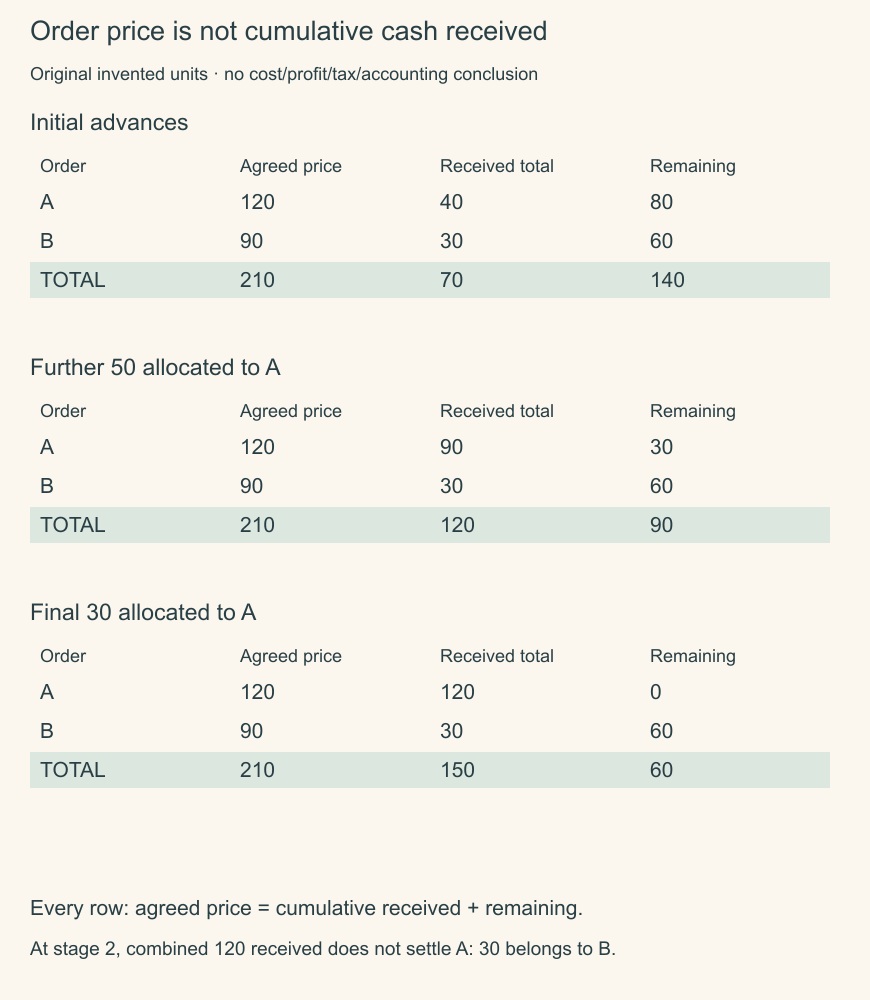
The first stage stipulates 40 units received for A and 30 for B. A's row reads 120 price, 40 received and 80 remaining. B's row reads 90 price, 30 received and 60 remaining. The totals are 210 agreed, 70 received and 140 remaining. Both row identities and the total identity balance: price equals received plus remaining.
Calling the 70 units sales completed would introduce an accounting conclusion this example has not established. Equally, treating A as fully paid because a payment exists would discard its remaining 80. The useful statement is literal: the model records 40 received against A and 30 against B, with the displayed amounts still unreceived under the stated prices.
Add another receipt without replacing the earlier one
Now stipulate a further 50-unit receipt specifically for A. Its cumulative received amount becomes 40 plus 50, or 90. A's remaining balance becomes 30. B is unchanged at 30 received and 60 remaining. Across both orders, cumulative receipts are now 120 and balances total 90; together they still equal 210.
This stage creates a deliberate trap: the combined 120 received equals A's full 120 price, but 30 of those receipts belongs to B. A is not fully paid. Nor should the new 50 replace the earlier 40 in A's cumulative field. The row must show both payments' combined effect while retaining the separate receipt history that explains it.
Finish one order while leaving the other open
A final 30-unit receipt is stipulated for A. Its cumulative receipts reach 120 and its balance reaches zero. B remains 90 price, 30 received and 60 remaining. The combined display is now 210 agreed, 150 received and 60 remaining. A has reached zero remaining balance within this model; B has not changed merely because another order is complete.
The original diagram shows all three stages in a vertical sequence. It also keeps the incremental receipts distinct: initial A 40/B 30, then A 50, then A 30. That makes the cumulative totals recoverable rather than asking a reader to trust a final paid label. There is no cost column from which to calculate a contribution, wage or profit.
Use the balance to ask a precise status question
An original internal note after stage 2 could read: Order A, agreed 120; receipts 40 and 50 allocated to A; cumulative 90; remaining 30. Order B, agreed 90; receipt 30; remaining 60. Check any actual discrepancy against the responsible transaction evidence before changing the record. The invented note does not establish an entitlement to demand a payment or a deadline for doing so.
For actual work, the agreed terms and appropriate professional guidance govern deposit handling and financial records. Here the useful purchase decision is smaller: no paid ledger tool is necessary to demonstrate the arithmetic, and a prettier invoice cannot allocate an unexplained receipt. Keep the order reference, incremental receipts and cumulative total connected before interpreting a zero balance.
Sources & further reading
Published sources for the details and examples discussed in this story.