A key ring or a book can identify a librarian very quickly, but it can also do all the storytelling work. For this original character exercise, leave both out. Imagine a night librarian who tends a fictional library after its visitors have gone. Three original digital silhouettes ask whether the outline should suggest a still presence, a spreading form or an interrupted edge. They share one plain head, neck and upright pose; none depicts a wearer or a garment pattern.
Begin with the same quiet gesture
The figure stands upright in each drawing, without a visible hand reaching for anything. Keeping that neutral gesture fixed lets the outer shape carry the comparison. The dark blue-gray fill is also unchanged. The drawings contain no face, lettered badge or copied film-costume detail, so the reader is not being asked to recognize an existing character.
This is a graphic story proposal rather than a claim about real library staff. The night setting is invented, and the outline does not establish a person’s temperament. I am choosing a possible visual language for one fictional role, not suggesting that a particular body shape signifies an occupation.
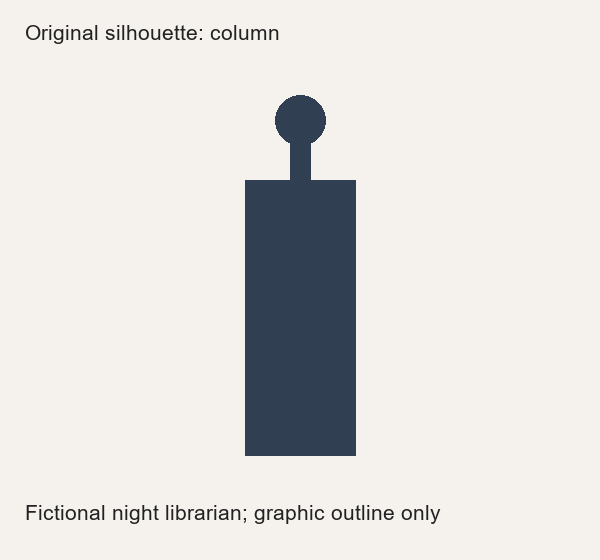
Column: a figure that stays like a marker
The first silhouette has a broad rectangular body with parallel sides. Against the pale background, its uninterrupted edges make a simple vertical presence. I would consider it for a night librarian imagined as a steady marker beside a desk: present, reserved and not carrying an elaborate visible apparatus.
That interpretation comes from the specific drawing. The rectangle does not prove that an actual long garment would hang straight, allow movement or suit a wearer. Its value at this stage is that it supplies a clear outline without requiring a book, lamp or decorative emblem to explain every part of the character.
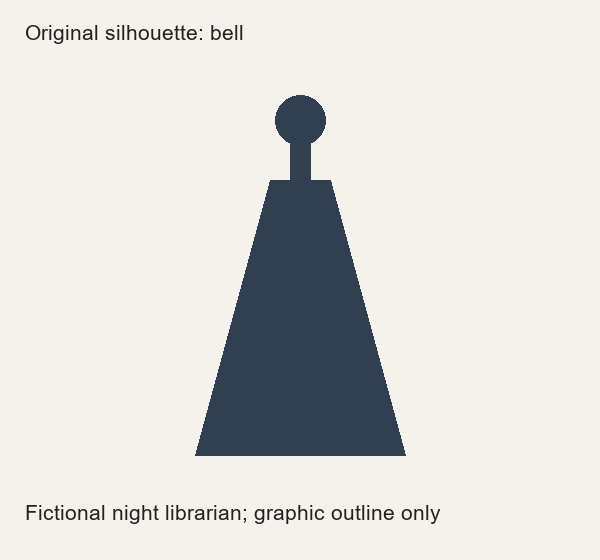
Bell: let the lower outline expand
The second silhouette begins narrowly near the shoulders and widens toward its lower edge. The head and upright gesture remain the same. I read the widening form as taking more graphic territory near the ground than the column does, which could suit an invented character whose presence seems to spread through a quiet room.
This is the direction I would investigate first for the fictional night librarian. The broad base offers a contrast with the small head without adding separate objects. That preference is about a flat image, not advice to make or wear a wide, trailing or restrictive costume. Real garment dimensions, visibility and movement would require another stage.
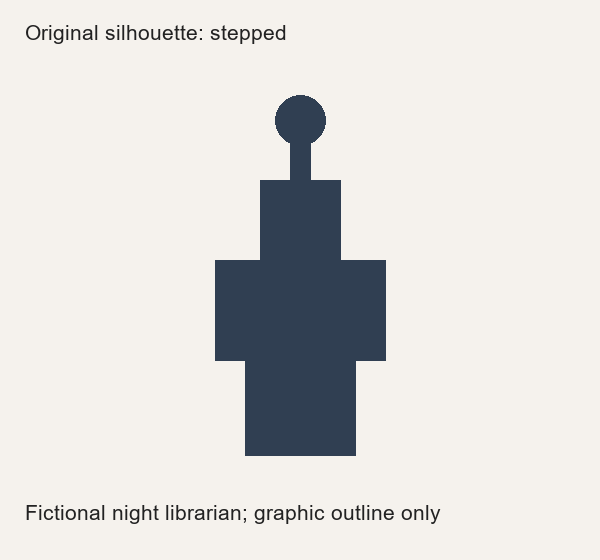
Stepped: make the edge change its mind
The third study widens in the middle and narrows again below. Its stepped edge introduces more changes of direction than either of the other studies. I imagine a more interrupted graphic rhythm, perhaps useful for a character who belongs among shelves but is not intended to resemble a moving stack of books.
Getty’s formal-analysis vocabulary distinguishes shapes and their boundaries. Here the three boundaries are original constructions, not examples copied from a costume archive. They do not supply construction instructions. Before buying props, decide which outline actually serves the character’s role in the proposed story. A borrowed everyday item may later be useful, but it should answer a specific need rather than rescue an undecided silhouette. Actual costume selection still requires product-specific and wearer-specific checks; this drawing exercise supplies none of those results.
Sources & further reading
Published sources for the details and examples discussed in this story.