Two crochet patterns can print the same letters while naming different stitches. The Craft Yarn Council's comparison pairs US single crochet with UK double crochet, and US double crochet with UK treble. A familiar dc therefore needs the pattern's declared terminology before it becomes an instruction you can interpret. This is a pattern-reading question to settle before buying the full project supplies, rather than a reason to guess from the cover photograph.
| Original card | Reading supported by the declared system |
|---|---|
| A: UK terms, dc | UK double; equivalent to US single in the cited table |
| B: US terms, dc | US double; equivalent to UK treble |
| C: dc, system unstated | Clarify the actual pattern's terminology |
Two original cards keep the missing field visible
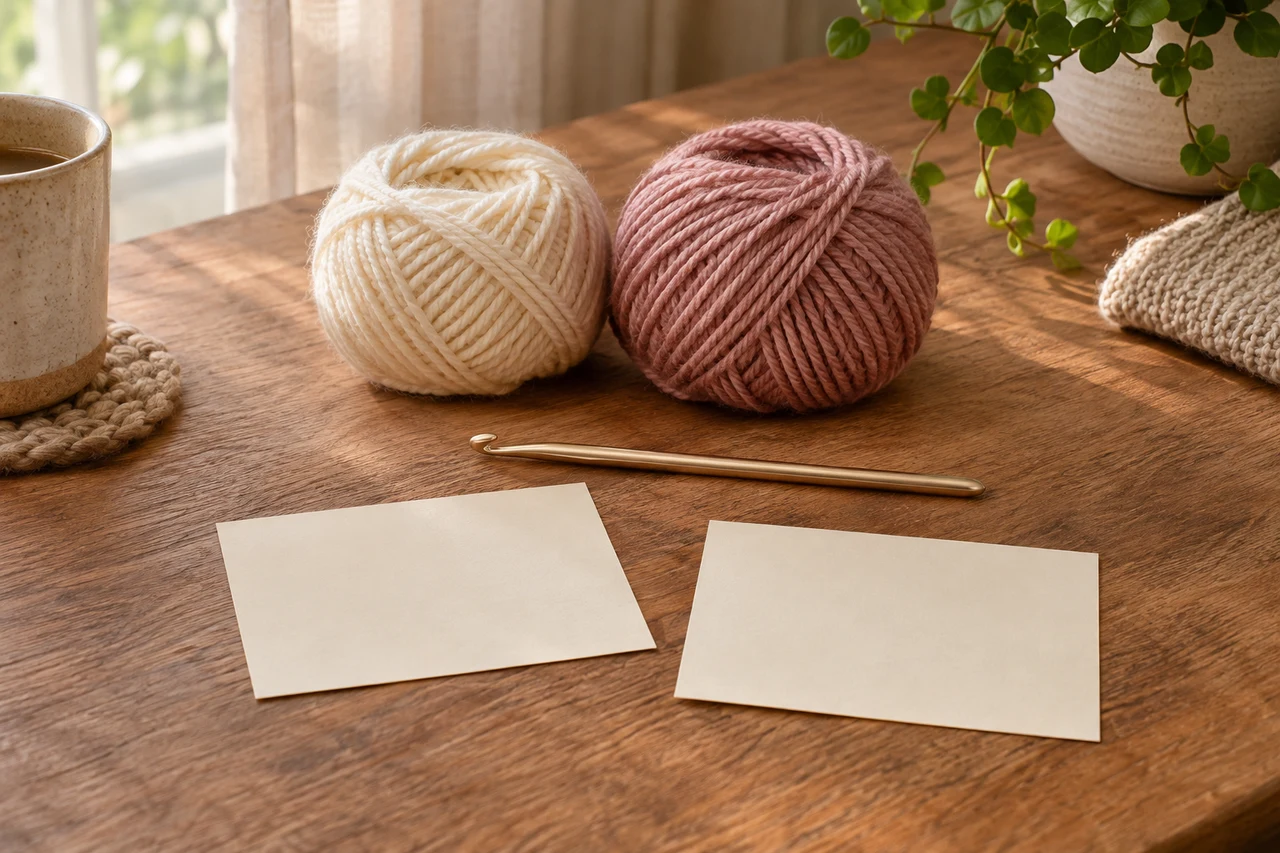
Imagine Card A explicitly marked UK terms and Card B explicitly marked US terms. Each contains the abbreviation dc. These are invented reading cards, not copied patterns or complete crochet instructions. On A, the term is UK double crochet, corresponding to US single crochet in the council's table. On B, it is US double crochet, corresponding to UK treble.
The letters have stayed the same while the declared system changes the interpretation. A third card showing only dc would leave that field unresolved. Do not choose the interpretation you happen to know and then treat it as proof that the pattern author supplied the same instruction.
Read the pattern's own opening information
The council says its master-list definitions reflect US terminology and notes that designers may supply special abbreviations defined in the book or pattern. Start with the actual project's terminology statement and its own key. A general reference helps interpret a declared system; it does not cancel a designer's explicitly defined special term.
Keep that key beside the relevant instruction when reading. An author's website address, a currency symbol or where you bought a download should not silently replace a terminology statement. If the actual pattern does not settle the question, seek the publisher's clarification before starting. No stitch sample or hook movement has been tested here.
Choose the project with the explanation you need
Before paying for a beginner pattern or kit, check whether the terminology and any unusual abbreviations are explained in the material supplied. A photograph of a finished bag can show an intended object without teaching the words used to make it. Look for instructions suited to the actual reading task, rather than buy more yarn to compensate for an unresolved term.
Once the system is clear, the project's yarn, hook, gauge, quantity and finishing still need their own instructions. A correct name mapping does not prove garment fit or turn the two invented cards into a usable pattern. The modest result of this exercise is confidence about which term is being read. Preserve that context whenever you copy a short line into a project note, so a familiar pair of letters does not lose the key that gave it meaning.
Sources & further reading
Published sources for the details and examples discussed in this story.