Before opening a second sheet of wrapping paper, a quarter turn may be worth considering. This worked example uses two invented required paper rectangles and one invented sheet. It is a flat layout problem, not a formula for wrapping actual boxes. The rectangles are stipulated to include whatever paper the imaginary task needs; no real folding allowance, seam or package dimension has been calculated. Two original diagrams make the difference between enough area and a workable arrangement visible.
| Hypothetical allocation | Dimensions or area | Meaning |
|---|---|---|
| Sheet | 60 × 40 cm = 2,400 cm² | Fixed outer boundary |
| Required A | 38 × 24 cm = 912 cm² | No trimming or joining |
| Required B, rotated | 18 × 24 cm = 432 cm² | Quarter turn permitted by model |
| Combined rotated block | 56 × 24 cm | Fits inside fixed sheet |
| Remaining non-overlapping pieces | 4 × 24 cm and60 × 16 cm | 96 + 960 = 1,056 cm² |
Declare the sheet and the required rectangles
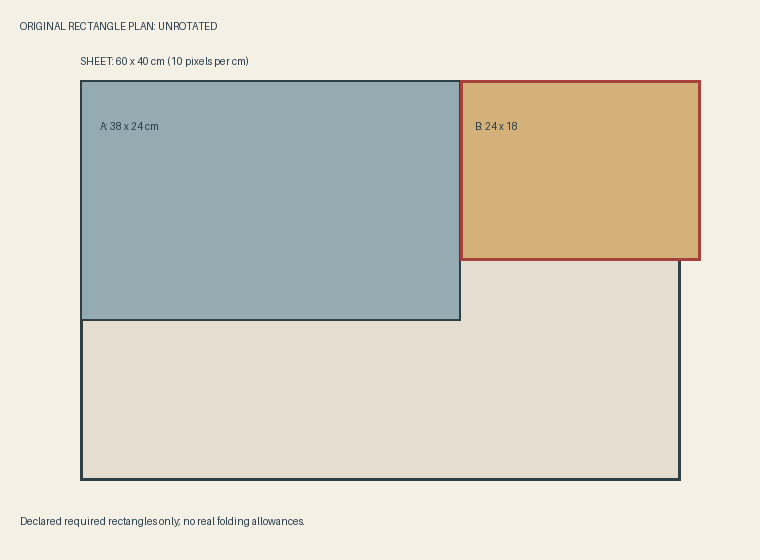
The hypothetical sheet measures 60 by 40 centimeters. Rectangle A requires 38 by 24 centimeters; rectangle B requires 24 by 18. Treat each as an indivisible rectangular footprint: the model does not permit joining scraps, overlapping the required pieces or changing their dimensions.
BYU–Idaho’s introductory area resource gives the rectangle calculation as length multiplied by width, with both sides expressed in the same units. Here that produces 2,400 square centimeters for the sheet, 912 for A and 432 for B. The required total is 1,344 square centimeters, leaving 1,056 in area. That arithmetic alone does not establish fit.
Without rotation, the two directions both run out
Keep A’s 38-centimeter side and B’s 24-centimeter side along the sheet’s 60-centimeter direction. Placed side by side, they require 62 centimeters, which exceeds the sheet by two. Stacking their 24- and 18-centimeter heights instead requires 42 centimeters, exceeding the other sheet dimension by two.
For these fixed, axis-aligned orientations, shifting the rectangles does not solve the problem. Their combined widths exceed the sheet width, so their horizontal spans must overlap somewhere. Their combined heights also exceed the sheet height, so their vertical spans must overlap somewhere. Both overlaps together mean the rectangles cannot remain separate within this sheet.
The first diagram illustrates the side-by-side failure: B projects beyond the right edge. It is a drawing of an impossible placement within the stated sheet, not a suggestion to cut a required piece short. There is enough total area, yet its shape does not support these two unrotated footprints.
Rotate B and check both dimensions again
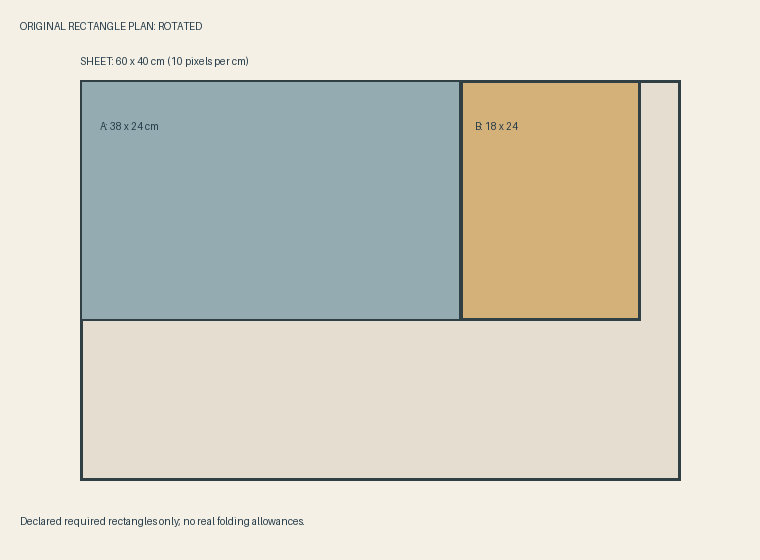
Turn B through ninety degrees in the model, giving it an 18-centimeter width and a 24-centimeter height. Beside A, the two now require 38 plus 18, or 56 centimeters, across. Both are 24 centimeters high. The combined 56-by-24 rectangle fits inside the 60-by-40 sheet.
In the second diagram, A starts at the upper-left corner and B sits directly beside it. There is a four-centimeter-wide strip to their right over that 24-centimeter height, plus a full-width strip below them measuring 60 by 16 centimeters. Those two non-overlapping offcuts have areas of 96 and 960 square centimeters, totaling the same 1,056 left by the earlier calculation.
The paper has not gained area. Rotation has made the required shapes compatible with its boundaries. Keeping the offcuts’ dimensions visible is useful too: a long narrow strip and a broad rectangle offer different possibilities for another known requirement. Their total area does not promise that either can wrap an unspecified extra gift.
Let a real package supply its own requirements
If the unrotated fictional plan used one sheet per footprint, two 60-by-40 sheets would supply 4,800 square centimeters and leave 3,456 unused after allocating A and B. The rotated plan uses one sheet and leaves 1,056. It saves opening one full sheet in this model, without proving that every real wrapping job can be reduced in the same way.
For an actual purchase, establish the paper needed for the particular boxes and intended wrapping method before borrowing these numbers. Printed direction, an unsuitable reverse side or other requirements may restrict rotation. Cutting space and practical handling also remain outside the exact-edge model. No real gift was wrapped or paper product tested here.
Choose the sheet size and quantity for the requirements you actually have. A roll, a set of small sheets and paper already owned are different offers, and a smaller price per area is not a guarantee of useful shapes. The calculation earns its place when it prevents an unnecessary second sheet—not when it becomes a universal allowance rule.
Sources & further reading
Published sources for the details and examples discussed in this story.