A decorative color sequence can change its rhythm without adding a fourth color or increasing its length. Two original eighteen-link plans use the same six rust, six green and six cream positions. One repeats a three-color unit throughout; the other begins with color runs and then breaks into alternation. The drawings are flat color-order proposals, not an assembled or installed paper chain. Their comparison concerns what the sequence makes visible, not fastening, hanging or child-safety instructions.
| Original plan | Positions1–9 | Positions10–18 | Counts and runs |
|---|---|---|---|
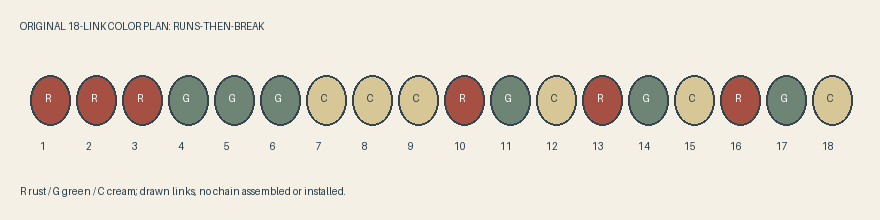
| Continuousrepeat | R G C / R G C / R G C | R G C / R G C / R G C | R6 G6 C6;18one-positionruns |
| Runs thenbreak | R R R / G G G / C C C | R G C / R G C / R G C | R6 G6 C6;3three-positionruns+9one-positionruns |
Keep the color budget the same
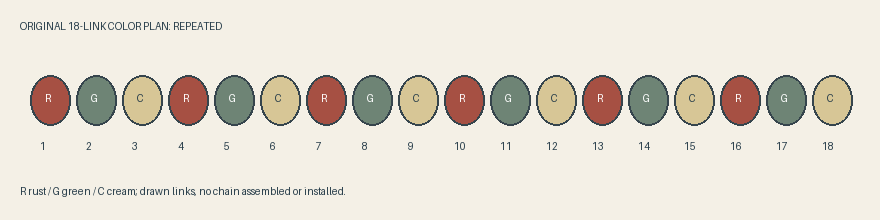
Use R for rust, G for green and C for cream. The letters remain beside the drawn colors so that the order does not depend on distinguishing the screen colors alone. Each plan has eighteen numbered positions, and each letter appears six times. We are comparing order rather than different quantities or materials.
Getty’s design guide discusses repetition, rhythm and variety as compositional ideas. Those terms help describe the plans, but they do not prescribe a universal holiday palette or predict anyone’s mood. The exact sequences and preference here are original.
First plan: return to the same three-step unit
The first order is RGC repeated six times. Positions one to three give the unit, and each later group repeats it without changing the order. Every adjacent pair has a different color, including the transition from cream back to rust at the start of the next unit.
I find this plan easy to read as a continuous repeated phrase. No particular position asks me to reinterpret the order. It would be my choice if the brief were to keep the color sequence even from beginning to end, rather than introduce a noticeable turning point.
That is a preference about the drawing’s organization. It does not show how a real chain would turn, overlap or appear from another side. An actual three-dimensional object could present its colors differently from these eighteen ovals on a page.
Second plan: change the size of the color event
The second order begins RRR, GGG and CCC. Its first nine positions form three runs, each containing three of one color. Positions ten to eighteen then use RGC three times. The palette and total counts remain unchanged, but the size of the repeated event changes halfway through.
The shift at position ten is the break I want to keep. A viewer first encounters blocks of color, then a succession of separate colors. The second half does not introduce a new shade to announce itself; it rearranges the six-of-each budget already available.
Counting adjacent same-color runs makes the distinction inspectable. The first plan has eighteen one-position runs. The second has three longer runs followed by nine one-position runs, making twelve runs altogether. This count describes the written sequence, not the visual effect of a completed hanging decoration.
Choose the break before buying more paper
My preference is the second plan when the purpose is a visible change in rhythm within one fixed-length decoration. The first remains useful when continuity is the point. Neither needs extra colors merely to seem more considered.
Before buying materials, keep the counts with the chosen order. Six of each color answers the sequence question; it does not establish strip dimensions, the amount of paper needed or an appropriate assembly method. No cutting, fastening, fire clearance or installation guidance is supplied by this plan.
Use actual material and household guidance for any real project, including who will make or handle it. A set sold for decoration does not become suitable for every user or location because its colors match the drawing. If the purpose is only to explore a visual sequence, the paper plan is already a complete result.
Sources & further reading
Published sources for the details and examples discussed in this story.