A pack of paper can have the size and weight you wanted while leaving a different question unanswered: which way does its grain run relative to the fold? Xerox's Nuvera Paper Guide distinguishes grain-long sheets, whose fibers follow the longer dimension, from grain-short sheets, whose fibers follow the shorter dimension. It recommends choosing stock that lets a planned fold follow the grain. That is a direction question, not another name for paper thickness.
Keep direction in a separate field
The cited guide explains that most fibers align during papermaking and that the way sheets are cut establishes the long- or short-grain relationship. It also identifies LG and SG as common abbreviations. Those descriptions are useful when reading an exact stock specification; they do not identify the grain of an unmarked sheet from a photograph.
Record the actual sheet size and the supplier's grain statement together. Do not assume that the word long describes a heavier paper or that short means a thinner sheet. Mass per area and caliper answer other questions. A shopping note needs the property that the proposed fold makes relevant.
An imagined sheet keeps the geometry simple
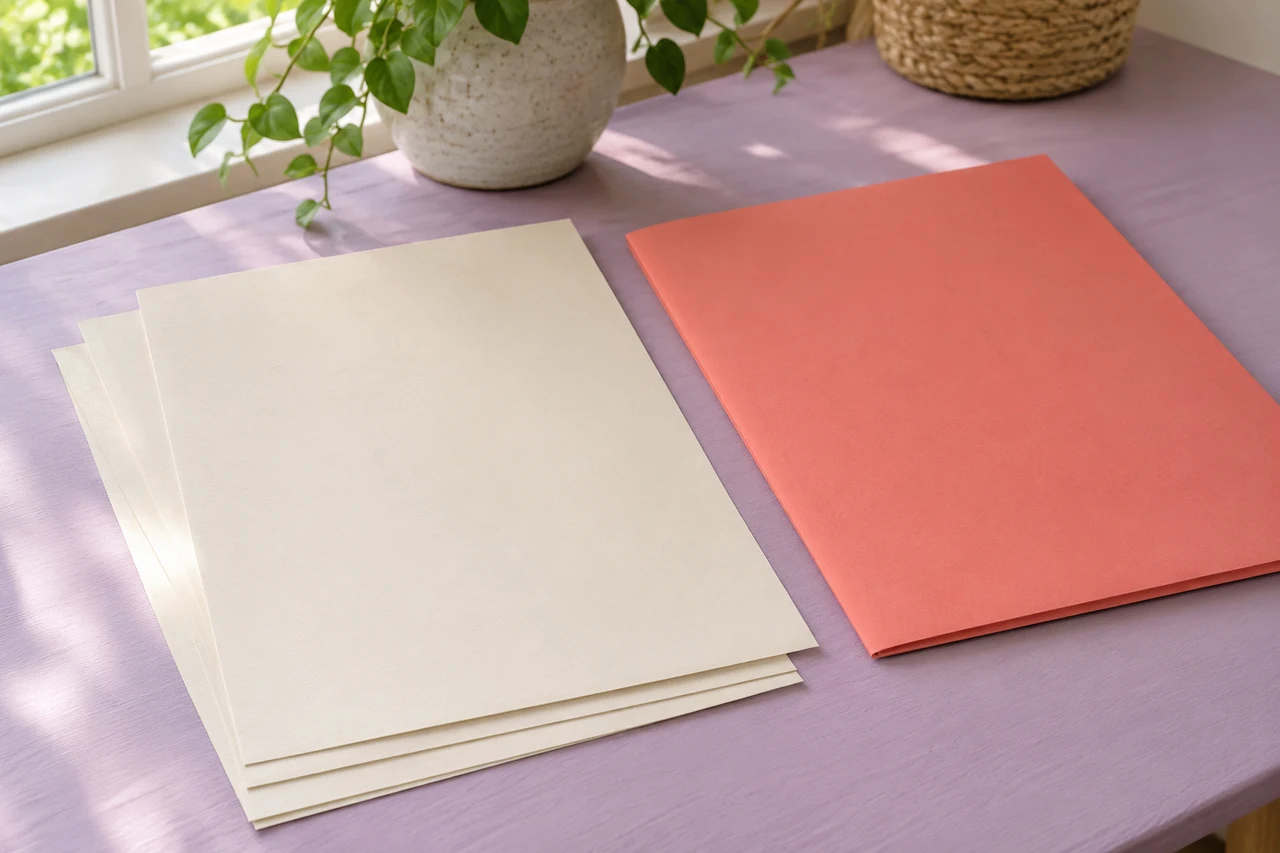
Imagine a hypothetical sheet measuring 21 by 30 centimetres whose supplier explicitly calls it grain long. In this invented example the grain follows the 30-centimetre direction. A proposed fold line parallel to that direction has a different relationship to the grain from a fold line parallel to the 21-centimetre direction. No real sheet has been folded or tested here.
Describe the fold line itself instead of saying only fold it in half. That casual instruction can hide which edge or direction someone means. For the example, one note can say fold line parallel to the long edge; another can say fold line parallel to the short edge. The source definition then gives a clear relationship to compare, without requiring an invented texture test.
A recommendation is not a tested result
Xerox recommends folding with the grain and describes cracking associated with against-grain folds in its paper guidance. Keep that as attributed guidance rather than promising that any with-grain fold will be flawless. The exact stock, coating and intended production process still need their own assessment. We have not examined the guide's diagrams as visual evidence or reproduced them.
Before buying a large pack for cards or a booklet, ask the supplier how the stated grain relates to the delivered sheet size and your proposed fold. A different cut size may require a fresh answer. Keep printer compatibility and any finishing instructions separate; this article does not supply Nuvera loading directions or advise operating cutting equipment.
Order for the project you can describe
The useful purchase brief identifies the stock, delivered sheet dimensions, grain direction and intended fold line. If a field remains unknown, ask for it rather than infer it from a pleasing color or a high GSM number. A suitable sample may support the actual maker's assessment, but no sample performance is reported here.
A clear direction note can prevent a bulk order from resting on the wrong assumption. It does not replace the craft project's complete instructions, and it does not rank all long-grain paper above short-grain paper. The relationship matters because of the particular fold you intend to make.
Sources & further reading
Published sources for the details and examples discussed in this story.