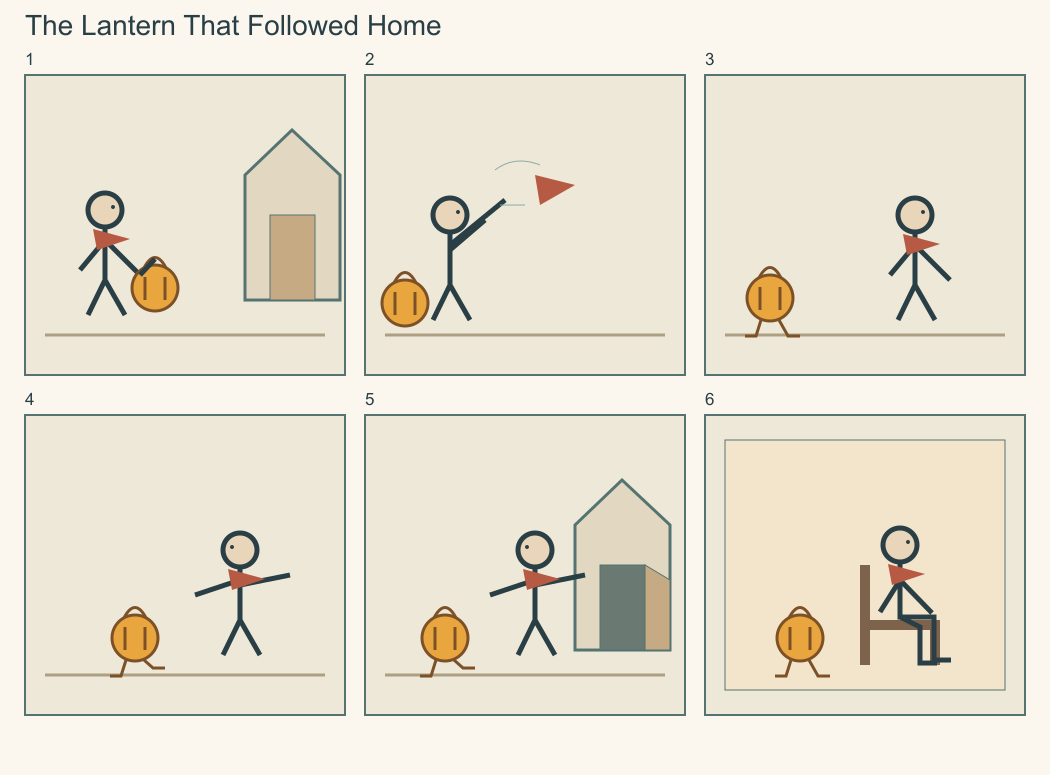
A person carries a lantern toward a small house. A windblown scarf interrupts the walk, and the lantern is left behind. The next change belongs to the object: it acquires two little legs and follows. This is the complete invented story drawn in the six-panel comic below. Its ending does not depend on a caption explaining a hidden family history or a character's spoken intention. The final image gives the lantern a place beside the person indoors.
Read the six panels in the declared order
The comic is arranged in two rows of three panels, read left to right across the first row and then across the second. The narrative images contain no dialogue, speech balloons or written signs. The page title and small panel numbers sit outside the depicted action as orientation aids. Calling the story wordless refers to the way its events are communicated, not a claim that a website contains no explanatory text.
The original character is a simple figure with a triangular scarf. The lantern has a round body and a curved handle; the house has a pointed roof and a single door. Those shapes return so the same people and objects remain identifiable across the changes. They are original geometric drawings, not a costume, branded character, copied comic panel or report of an event.
Panel 1: make the ordinary relationship legible
The first panel places the person on a path, holding the lantern beside the body. The scarf and house establish two visual anchors that will matter later. At this point the lantern is an object being carried. There is no reason yet to assign it independent movement or imagine a conversation between the two.
I want the house to be visible early because it gives the walk a destination before the disruption. Without that anchor, a later door could feel like an unrelated setting introduced only to end the story. The small initial house does not tell us who owns it or how far away it is. The comic needs a direction of movement, not an invented address or travel time.
Panel 2: interrupt the carrying action
The scarf has blown away from the person. The figure reaches toward it while the lantern rests on the ground. This separates the carried object from the carrier through a visible action rather than an unexplained jump. The lantern's round body and handle stay unchanged, so the reader can connect the object on the path with the one held in panel 1.
The disruption is deliberately modest. No person is threatened, locked out or pursued by a dangerous figure. The story's Halloween element will be the object's impossible movement. That keeps the surprise in a change of agency: an ordinary light becomes something that can decide to follow. The scarf gives the person a reason to put it down without requiring a dialogue balloon.
Panel 3: let the reader notice before the person does
The person has recovered the scarf and is walking on. Behind them, the lantern now has two little legs. This is the visual turn. The scarf's return makes the small earlier task look finished, while the new legs create an unfinished relation between the person and the object left behind.
The figure is not yet facing the lantern. I read that separation as allowing the viewer to notice the impossible change first. It is an interpretation of this drawn sequence, not a measured result from readers. Another reader may attend first to the scarf; the complete panels let that response be discussed rather than replaced by a claim that everyone experiences the same surprise.
Panel 4: make following different from a repeated pose
The lantern has moved closer to the person, with its legs in a walking position. The person turns toward it. Both changes matter: the object is no longer merely pictured with feet, and the figure's orientation now acknowledges it. The space between them supplies a relationship the first panel did not have.
A single isolated drawing of a legged lantern would only establish an odd creature. In sequence, the same handle and body connect it to the object that was carried, set down and left behind. I prefer keeping those features stable over adding more decorative faces or a different lantern silhouette. The event is clearer when the object changes one important capacity while retaining its identity.
Panel 5: give the person an answering action
The person holds the house door open and gestures toward the lantern. The lantern faces that opening. The comic does not print welcome or state what the person feels; the open threshold and invitation-like gesture are the response available to interpret. They move the story beyond a surprise that merely follows someone indefinitely.
This is also why the house appeared in panel 1. The destination now becomes a shared possibility. The person has not discarded the recovered scarf or turned into a new character. The continuing scarf shape helps connect the figure at the threshold with the walker, while the lantern's small legs keep its independent movement visible.
Panel 6: resolve the relation with a resting place
The final panel places the person in a chair indoors, the scarf still visible, with the lantern beside the chair. Both are at rest. The lamp has not been returned to an outdoor path or hidden in a cupboard; it occupies a place in the same interior as the person. That is the complete ending proposed by the drawing.
I read the change as carried object, abandoned object, following companion and finally welcomed presence. The ending does not need a speech explaining friendship or a promise of another adventure. Its resolution is spatial and behavioral: the person stops walking, the lantern stops following and the two share the room. The house that was once ahead of one traveler now contains both.
Use the whole sequence before adding decoration
For an original paper display, keep all six panels together or preserve their numbered order. Cutting them apart could become a separate sequencing exercise, but the comic itself is not a deduction game with one hidden word to extract. There is no answer-card route, real treasure hunt or requirement to purchase a lantern prop.
If redrawing the proposal, check the continuing scarf, handle, path direction and final chair relationship before adding seasonal ornaments. Those are the features carrying this particular story. No physical craft sample or reader test is claimed here. The complete digital narrative offers a concrete sequence to read, question or redraw, while leaving its impossible walking light within fiction.
Sources & further reading
Published sources for the details and examples discussed in this story.