An empty box in a weekly plan can look like unused capacity. In this original comparison, it is a choice about when to defer a task. Two fictional schedules have exactly five equal slots. One fills all five; the other reserves Friday. A late request then needs that Friday slot. The reserved plan accommodates it without changing a written task, but it has not created a sixth place or completed more work. Its cost was visible before the request arrived.
Give both plans the same capacity
The model has one thirty-minute slot from 18:00 to 18:30 on each weekday, Monday through Friday. Every named task takes exactly one slot and can be done in any available slot unless the late request supplies a deadline. There is no travel, preparation, overrun or simultaneous work. Those are declared fictional assumptions, not estimates for a real household.
Five ordinary tasks are available: A, sort printed photos; B, write a personal letter; C, read a chapter; D, arrange one pantry shelf; and E, choose a weekend recipe. These labels describe what is scheduled, not instructions for completing the tasks. No actual shelf, letter or household deadline was examined.
Write both complete starting schedules
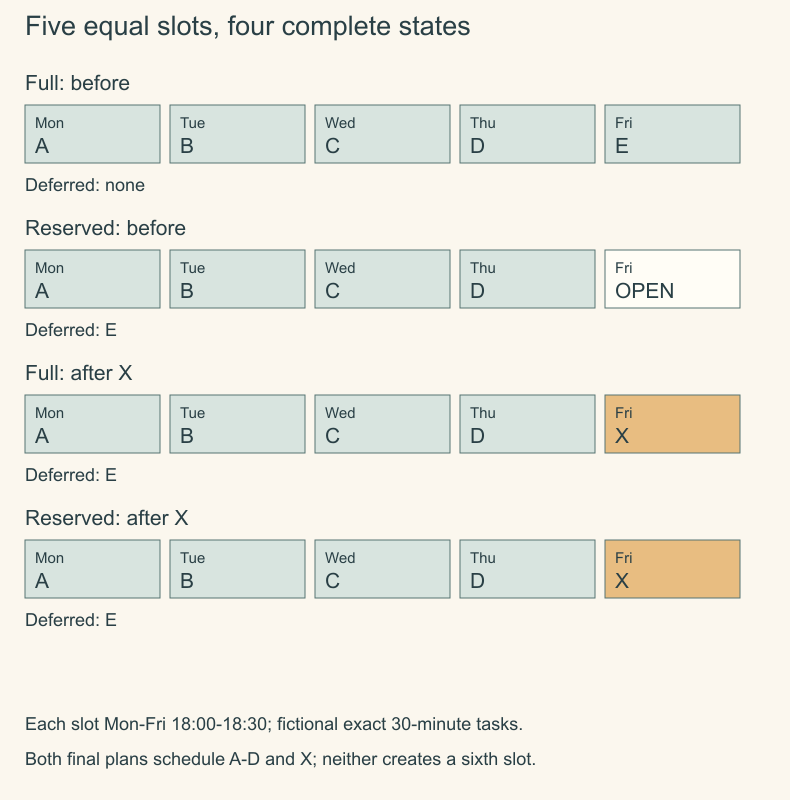
The full starting plan is Monday A, Tuesday B, Wednesday C, Thursday D and Friday E. All five ordinary tasks have a place. Nothing is deferred in that version before the new request. Its apparent advantage is straightforward: if the model proceeds unchanged, E is scheduled within this week.
The reserved starting plan is Monday A, Tuesday B, Wednesday C, Thursday D and Friday OPEN. Task E is explicitly deferred beyond this five-slot week. Do not erase E from the task list to make the opening look free. The second plan has chosen flexibility at the expense of assigning E now, while the first has chosen an ordinary task for that capacity.
Introduce the same late request into both plans
After Thursday's slot D has finished, an invented request X arrives: prepare a birthday-card envelope by the end of Friday's slot. X is declared to need one thirty-minute slot. The scenario supplies no real postal cutoff, event date or guarantee that an actual card could be prepared in that time. Those facts are not needed for the capacity comparison.
In the full plan, Friday E must be revised to Friday X if X is accepted and the stated deadline is kept. E moves to the deferred list. In the reserved plan, Friday OPEN becomes Friday X and E stays on the deferred list where it already was. Both resulting schedules are Monday A, Tuesday B, Wednesday C, Thursday D and Friday X.
Compare the result and the revision separately
By the end, both plans have scheduled A, B, C, D and X, with E deferred. Their completed-task capacity is identical. What differs is the earlier commitment: the full plan had to withdraw E's Friday place after X arrived, while the reserved plan had not promised that place to E. The diagram keeps all four states visible so the word buffer cannot hide a task.
For this invented household, I would reserve Friday only if postponing E in advance were acceptable and avoiding a later change mattered. If E had a real Friday deadline too, the opening would not solve the conflict. The household would need a different actual arrangement; squeezing two declared thirty-minute tasks into one slot would contradict this model.
Sources & further reading
Published sources for the details and examples discussed in this story.