
A ribbon can be part of a gift's decoration and also cover the information needed to give it to the right person. This original flat design comparison uses one declared package top, two name-tag placements and a moved ribbon. It is not a wrapping allowance calculation or a physically tested attachment. The question is smaller: after changing the decorative layer, can the intended reader still find the complete recipient name?
Declare the top and the two ribbon positions
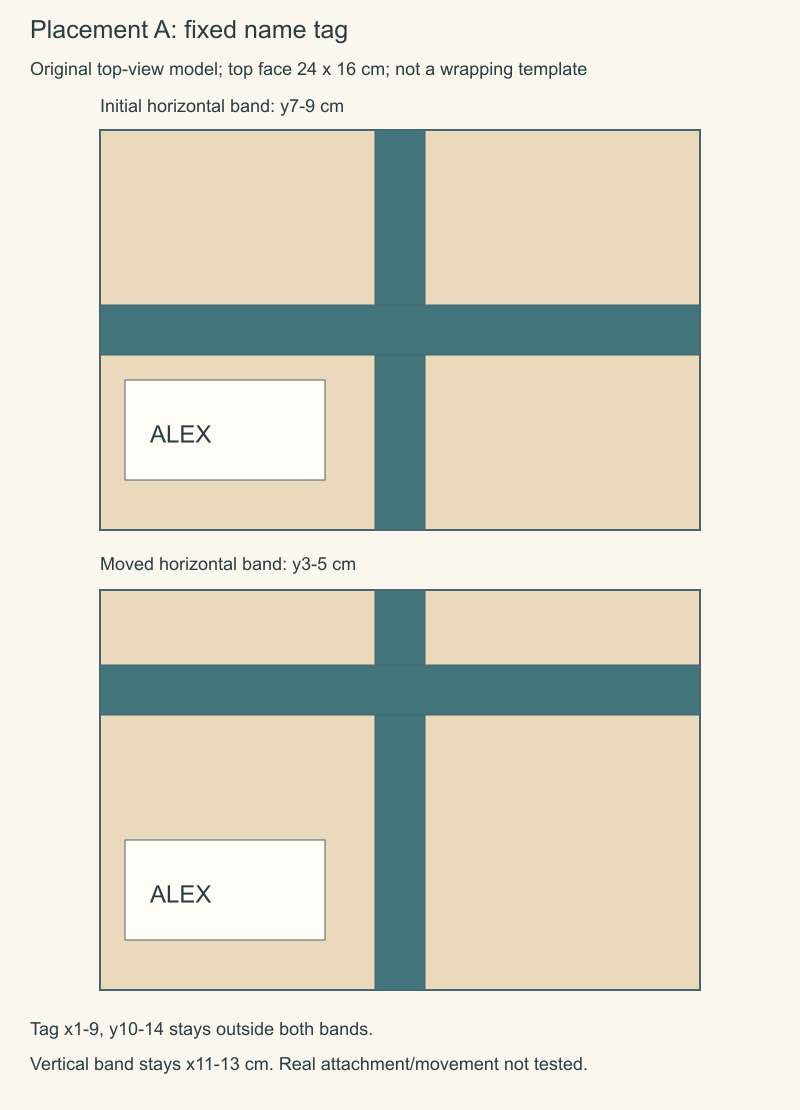
The imaginary package has a top face 24 cm wide and 16 cm high. In the diagrams, the upper-left corner is the origin; x increases to the right and y downward. A vertical ribbon covers x11 to13 for the full height. A horizontal ribbon initially covers y7 to9 across the width, then moves upward to y3 to5. Neither ribbon changes width.
These dimensions describe the visible top only. They do not establish paper lengths, folds, bow size or how a real ribbon moves around a box. The model treats the ribbons as opaque bands. Any name area beneath a band is therefore obscured, even if a particular real material might be translucent. This keeps the comparison about placement rather than an untested product property.
Placement A gives the name its own fixed location
Place a separate flat tag at x1 to9 and y10 to14. Keep the name inside x2 to8 and y11 to13. In this example the recipient is ALEX, centered within that declared name area. The tag is assumed to have an independent attachment that holds its stated position; no adhesive, paper or real attachment has been tested.
The vertical ribbon starts at x11, beyond the tag's right edge of9. The initial horizontal ribbon ends at y9, above the tag's top edge of10. After the horizontal ribbon moves upward, it remains above the tag. Both decorative states therefore leave the whole declared name area outside both opaque bands. The conclusion follows from the positions, not from the visual size of letters in a photograph.
Placement B follows the crossing and needs another check
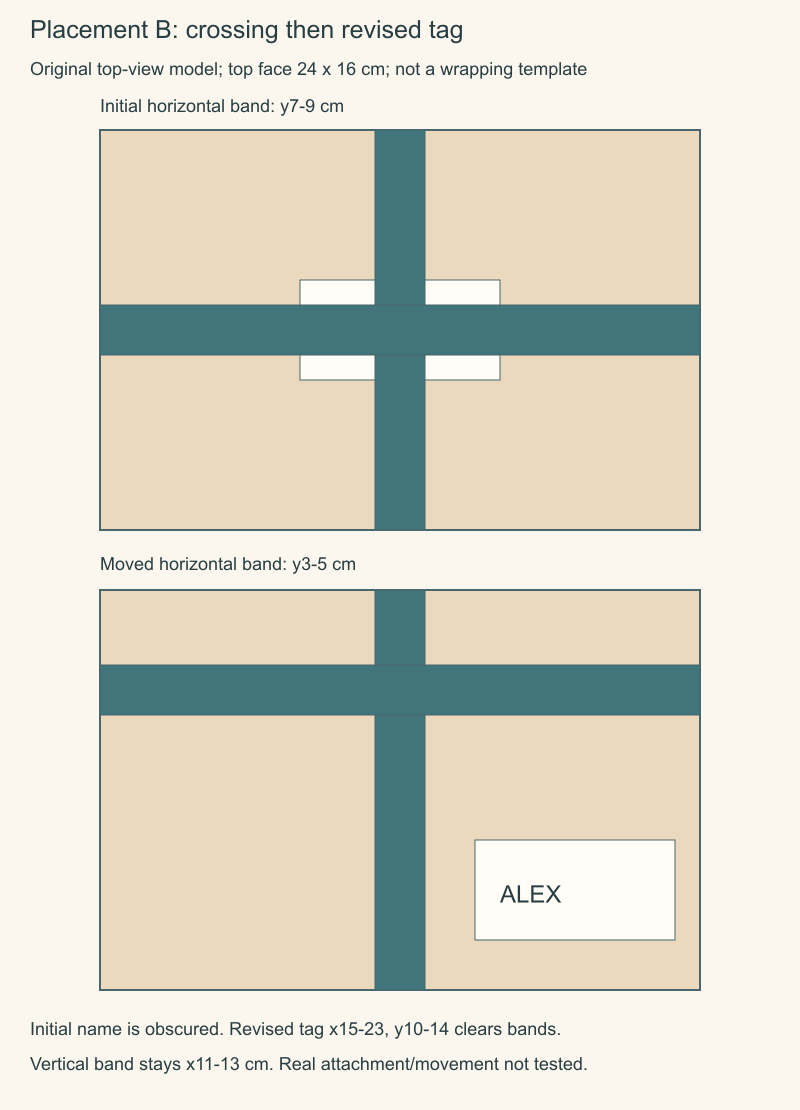
For contrast, put a tethered tag at x8 to16 and y6 to10, with its name area x9 to15 and y7 to9. Initially that name area sits under the horizontal band, while the vertical band also crosses it. Moving only the horizontal ribbon upward reveals some of the area but leaves x11 to13 covered by the unchanged vertical ribbon. One moved layer has not resolved the other obstruction.
A revised tethered placement can put the tag at x15 to23 and y10 to14, with the name inside x16 to22 and y11 to13. That position clears both bands in the declared flat model. But if the tie later lets the tag swing, the fixed coordinates no longer describe it. The revised design therefore needs a fresh visibility check after the actual decorative adjustment, unlike the stipulated independent attachment in A.
Read the name after making the decorative change
The two alternatives serve different intentions. A makes the recipient name a separate fixed part of the top. B lets the tag participate in the ribbon arrangement, at the cost of checking its resulting position. Neither alternative needs a universal claim that every attached tag is better than every tied tag. The useful choice depends on whether the information is meant to move with the decoration.
Before buying an extra tag or another ribbon, try the placement with materials already appropriate to your project and check the whole intended name in its final state. Do not count on a recipient guessing letters from a partly covered word. For several gifts, preserve the distinction between the decorative motif and the actual recipient identifier; matching colors alone cannot replace a readable name.
Sources & further reading
Published sources for the details and examples discussed in this story.