The small paper pumpkin has gone missing during an invented Halloween gathering. Nora, Owen and Pia each carried a different prop into a different room. Four evidence cards are all true. Together they identify the person carrying the basket that contains the pumpkin. This is a cooperative paper puzzle, not an accusation about a real guest or a physical search activity. The complete player materials and separate answer show exactly what information the solution uses.
Give players the entire world of the puzzle
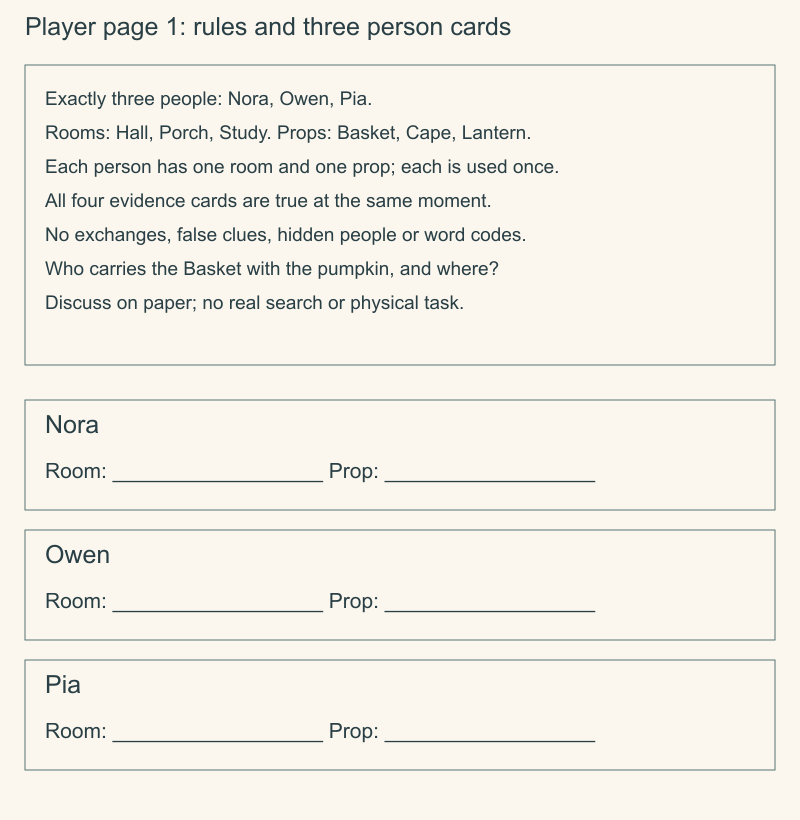
There are exactly three people: Nora, Owen and Pia. There are exactly three rooms: Hall, Porch and Study. There are exactly three props: Basket, Cape and Lantern. Each person is in one room and carries one prop. Every room is occupied by one of the three people, and every prop is carried by one of them. No two people share a room or prop in this model.
All four evidence cards are true, refer to the same moment and use the names exactly as printed. There are no secret guests, later exchanges, false witnesses or hidden meanings in the capitalization. The missing pumpkin is inside the basket, as card 4 establishes. The question is: who carries that basket, and in which room are they?
Give the players the rules, three person cards and four evidence cards. Keep the answer table apart until they want to check. People can discuss the possibilities together; no timed race, locked box, darkness or real object needs to be introduced. The printable materials contain everything needed for this finite deduction.
Read the four original evidence cards
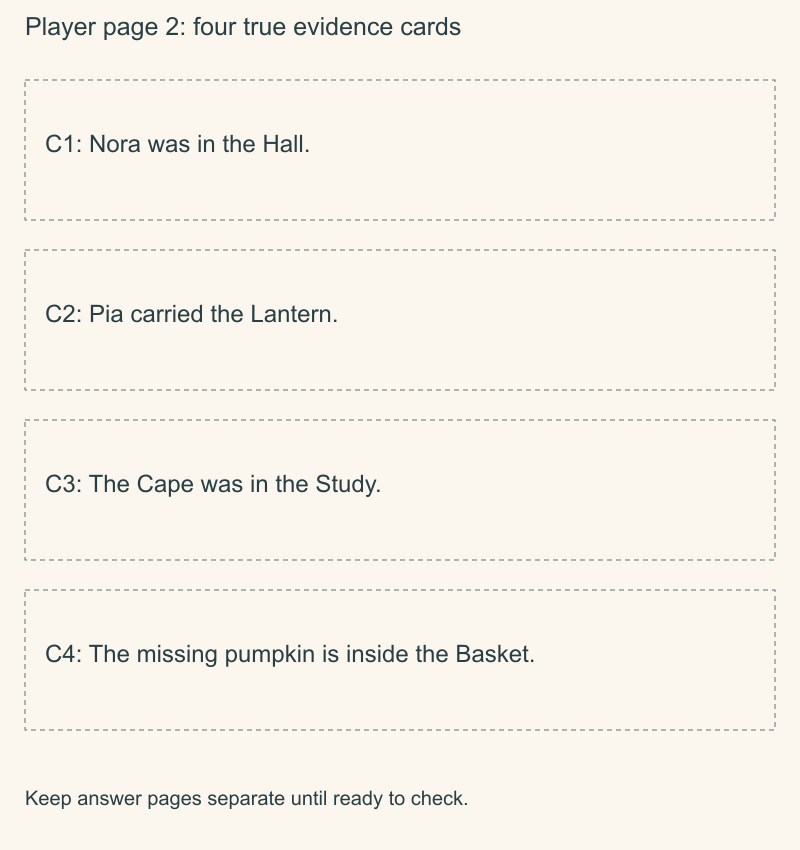
Card 1: Nora was in the Hall. This fixes one person-room relationship. It does not say which prop Nora carried. The distinction is important because the story asks for a person, a room and the basket; a partial answer should not be expanded into the rest by guessing.
Card 2: Pia carried the Lantern. This fixes one person-prop relationship. Pia must still be assigned a room that is consistent with the other cards. The word lantern is an ordinary label in the game, not an instruction to inspect a household light or find a decoration shaped like one.
Card 3: The Cape was in the Study. This relates a prop to a room, rather than naming a person. Whoever carries the Cape is the person occupying the Study. It is not a second room occupied by a loose cape, because the setup already says that every prop is carried by one of the three people.
Card 4: The missing pumpkin is inside the Basket. This connects the completed assignment to the story's question. It supplies no additional person-room restriction; its job is to tell us which prop to follow once the relationships are known. Four cards need not perform four identical elimination steps.
Follow the shortest complete deduction
Nora is in the Hall from card 1, so Nora is not in the Study. Pia carries the Lantern from card 2, so Pia does not carry the Cape. Card 3 places the Cape in the Study. The Cape carrier can therefore be neither Nora nor Pia. Owen must carry the Cape and be in the Study.
With Hall occupied by Nora and Study by Owen, the only remaining room is Porch, so Pia is in the Porch. Pia already has the Lantern and Owen has the Cape. The remaining prop is Basket, which must belong to Nora. Card 4 places the pumpkin in that Basket. The answer is Nora, in the Hall.
The complete assignment is Nora—Hall—Basket; Owen—Study—Cape; Pia—Porch—Lantern. Every person, room and prop appears once. The answer includes Owen and Pia because checking the whole assignment is stronger than stopping as soon as Nora seems plausible. A guessed culprit could be right for the wrong reason while leaving contradictory room assignments unnoticed.
Check uniqueness with the full candidate table
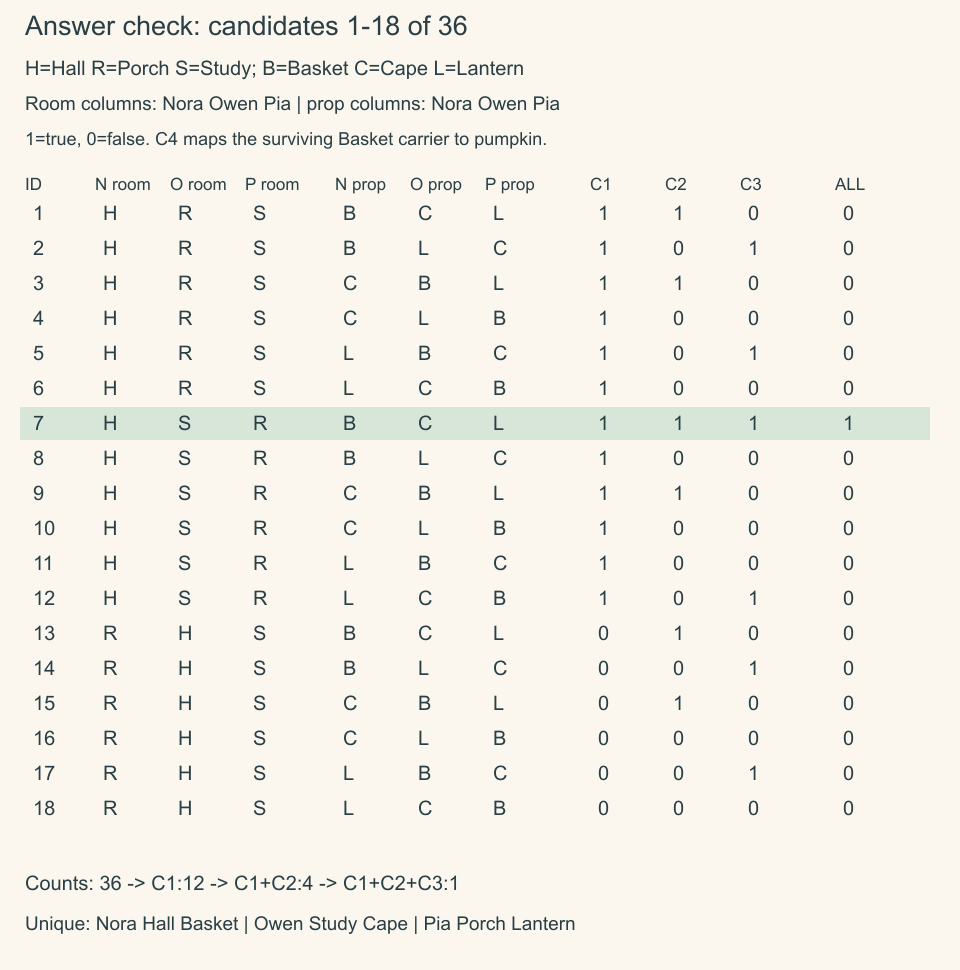
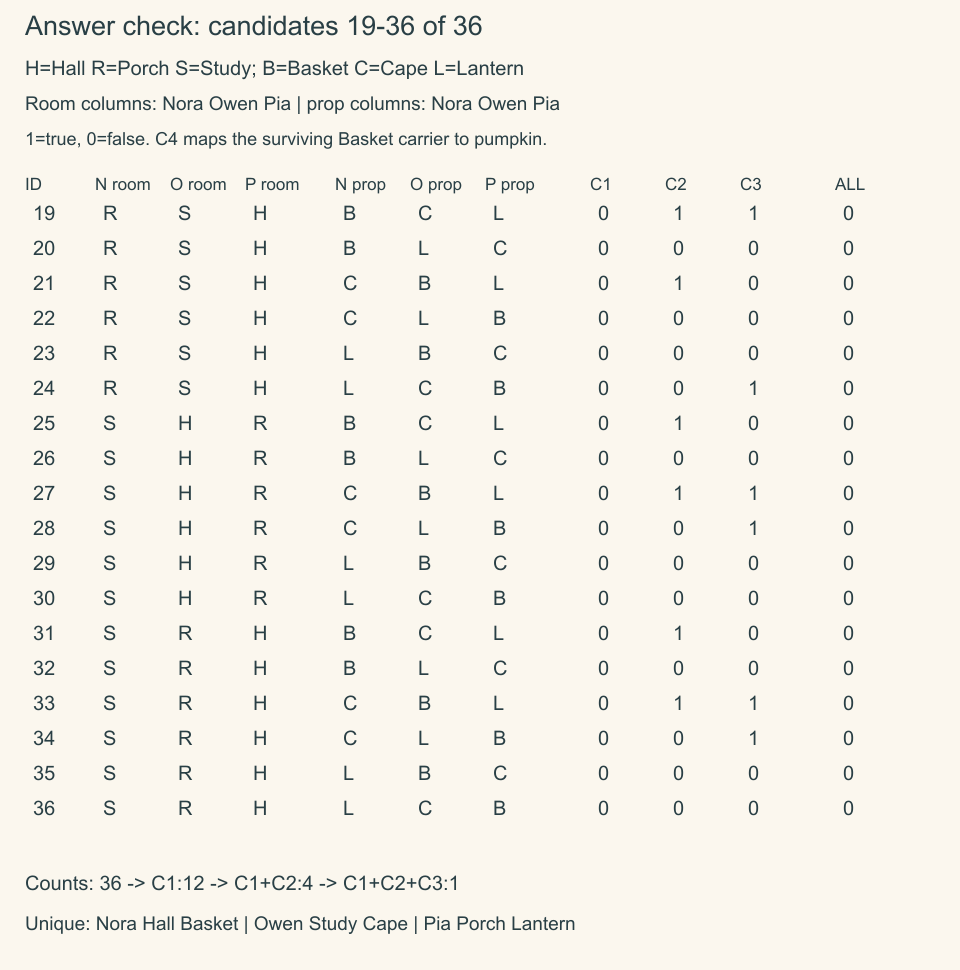
There are six ways to assign three different rooms to three named people and six ways to assign three different props. Together they produce thirty-six candidate assignments. The accompanying original truth table lists all thirty-six, rather than sampling only arrangements that appear promising. Two bounded images show the complete rows and their truth values, with the sole surviving assignment marked explicitly.
Card 1 leaves twelve candidates. Applying card 2 as well leaves four. Applying card 3 leaves exactly one complete assignment, the one stated above. Card 4 then maps its Basket carrier to the missing pumpkin. It does not reduce the assignment count again, and the table does not pretend that it does.
The table is a logic check of the authored rules. It is not evidence of a successful party, a measured difficulty level or a claim about a particular age group. No participant test is reported. The useful certainty is narrower: under the declared one-to-one assignments and all-true cards, the supplied answer is unique.
Compare an incomplete reading with the complete one
If a player uses only cards 1 and 2, four assignments remain. They can place Nora in the Hall and give Pia the Lantern while still exchanging the remaining room and prop relationships in several ways. The basket carrier is not settled by those two facts alone. Calling one of those partial arrangements the answer would add information the cards have not supplied.
Card 3 is what connects the two types of relationship. It pairs Cape with Study, allowing the exclusions about Nora's room and Pia's prop to identify Owen. This is the puzzle's substantive turn. The Halloween names decorate a complete constraint system rather than replace the rule needed to solve it.
When checking a proposed revision, preserve the actual one-to-one rules and rerun the candidate table before printing. Changing a person on one card can remove the unique solution or make the cards contradictory. A more elaborate prop does not repair that logic. Keep the original answer separate from any new version instead of assuming the same person must still hold the basket.
Let checking finish the game
An appropriate ending is for the group to read the complete answer and compare it with their assignment. If a clue was misunderstood, identify the relationship it was intended to express. There is no need for a punishment, a secret physical task or a claim that the person holding the Basket has behaved badly; the story only asks where the paper pumpkin is.
The printed deck can be tried with ordinary paper before any decorative purchase. Its player cards and evidence are complete as written. Optional feedback should record what real readers actually found unclear if the game is later used, rather than turn this proposed puzzle into an invented account of delighted guests.