A moving paper-bag mouth needs no screen or projected shadow. This adult project adapts the construction and short-performance idea in Crayola’s complete Paper Bag Puppets lesson. The courier, gardener and dialogue below are original. No puppets have been physically made or performance timed here.
Prepare two bags and a working mouth
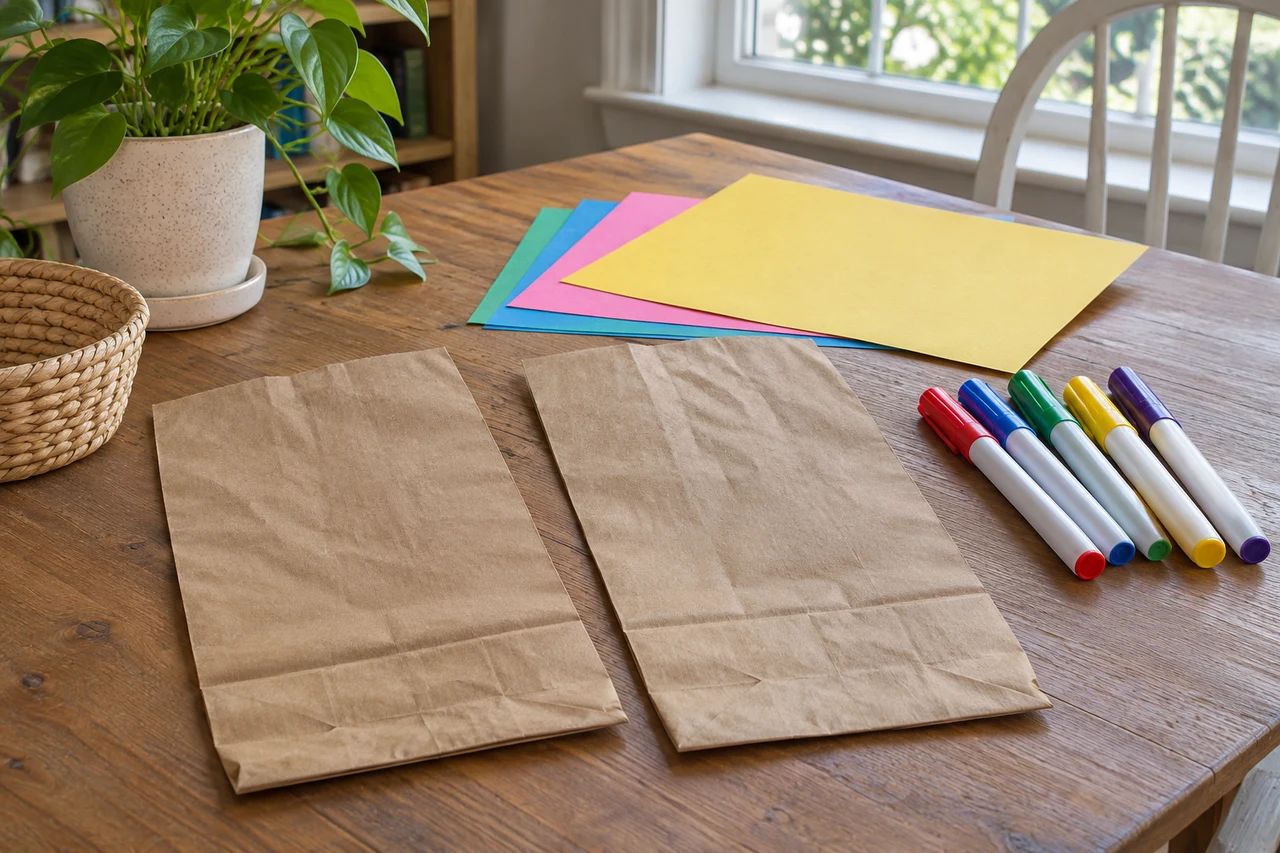
Gather two clean paper lunch bags, plain paper, markers, scissors, tape and glue suitable for the actual materials. Follow the tools’ and adhesive’s directions. Choose plain bags that can accommodate the intended adult hand without forcing; no particular bag size or fit is guaranteed by this proposal.
With a bag flattened, orient its open edge downward and its folded, closed bottom at the top facing you. Crayola uses that folded bottom as the mouth flap, while the open edge remains the hand entrance. Do not cut open the closed bottom. Keep the flap free to move and leave the hand entrance unobstructed.
Make a courier and a gardener
For the courier, draw two simple eyes on the upper flap and a jacket outline on the bag body below it. Draw a small square badge as a plain shape, without a copied company logo. Add a paper rectangle as a pretend envelope on the body, attaching it clear of the moving mouth.
For the gardener, draw different eyes on the second flap and an apron outline below it. A simple leaf drawn on the apron distinguishes the character without needing loose decorative pieces. Optional flat paper arms can attach to the body sides, away from the mouth and entrance. Use the actual adhesive instructions, including setting requirements; no invented drying time is supplied.
Once the materials are ready for handling, insert a hand through each open edge and investigate the folded flap’s movement gently. Adjust misplaced decoration before performing. Do not glue the flap to the lower bag face or add an attachment that prevents the opening action.
Read The Envelope That Took a Detour
Use two adult performers if both characters will move at once; alternatively, read the voices separately with one puppet active at a time. This complete twelve-line exchange is an original proposal, not a transcript of a tested show.
Courier: I have an envelope for the keeper of the green gate.
Gardener: My gate is blue, but my apron is green.
Courier: Then I have followed the apron instead of the address.
Gardener: Does the envelope say anything about an apron?
Courier: No. It says to leave it with the keeper.
Gardener: I keep these seedlings, but I do not keep that gate.
Courier: I was hoping the word keeper would do all the work.
Gardener: Words sometimes need their neighbors.
Courier: Green belongs to gate, then.
Gardener: And the gate belongs along the next path.
Courier: I shall take the unopened envelope there.
Gardener: Come back afterward; this blue gate welcomes a visitor.
Finish with the project you actually wanted
Keep this an invented conversation rather than a reenactment of a delivery job. An ordinary table can supply a performance boundary without building a stage. Do not assume a puppet must have a complete costume or purchased kit before it can speak.
Afterward, put tools and offcuts away appropriately. If revising, change one character’s reply and see whether the misunderstanding still resolves in the dialogue. The project supplies a physical mouth and a complete authored exchange; it makes no claim about learning, dexterity or therapeutic outcomes.
Sources & further reading
Published sources for the details and examples discussed in this story.