A timed museum ticket can raise two quite different questions: what happens if you reach the entrance late, and whether you can leave after entering and return later. At the Louvre, those questions lead to separate published conditions. The first changes the admission and waiting arrangement described for an online ticket holder who misses the allocated slot. The second concerns an exit after admission. Keeping the two moments separate prevents a travel plan from borrowing an answer that belongs to another stage of the visit.
Put the visit in order before interpreting the ticket
Consider an invented visit with a ticket marked 10:00. The traveler has not yet entered the museum and arrives after the allocated admission slot. This is a late first-arrival problem. Now imagine a different traveler who has already entered, spends time in the galleries and proposes going outside before returning. That is an exit-and-re-entry problem, even if the clock still shows the same day printed on the ticket.
The clock alone cannot distinguish these cases. Both travelers may be standing outside at noon, but one has never used the admission and the other has ended an admitted visit. A useful planning note therefore records not only the proposed time but also whether entry has occurred and whether an exit is proposed. These are original examples, not actual bookings or accounts of a staff decision.
Read the late-arrival answer completely
The Louvre's FAQ says that visitors with time-stamped tickets have reserved access through a dedicated line at the Pyramid or Carrousel entrances. Its next sentence addresses an online ticket holder who does not arrive within the allocated admission slot: the person is subject to the same admission and waiting conditions as visitors without tickets and must use Pyramid access.
That answer gives the late traveler a different stated admission and waiting condition. It does not give a replacement guaranteed entry time. Nor does it say that walking to the Carrousel will preserve the dedicated-line arrangement after missing the slot. The particular entrance instruction is part of the answer, not a detail to discard while keeping only the reassuring fact that the ticket exists.
For the invented 10:00 traveler, the planning conclusion is therefore limited: do not continue to schedule the day as though the original dedicated-line access were unchanged. Consult current official instructions and staff about the actual situation. The FAQ does not support a calculation such as ten minutes late means ten extra minutes waiting, and this article supplies no queue measurement.
An exit is a different event
The Louvre's separate re-entry FAQ states that any exit is final. The museum-rules page repeats that condition under Leaving the museum. This is not the late-arrival sentence expressed another way. It applies a boundary after entry, whereas the late-arrival passage describes the conditions under which an initial admission is approached.
The second invented traveler cannot use the missed-slot answer to justify leaving for an outside appointment and returning on the same ticket. Having entered earlier does not turn a second arrival into a delayed first arrival. Equally, the final-exit rule should not be used as a reason to describe the first traveler as having already exited: that traveler has not entered at all.
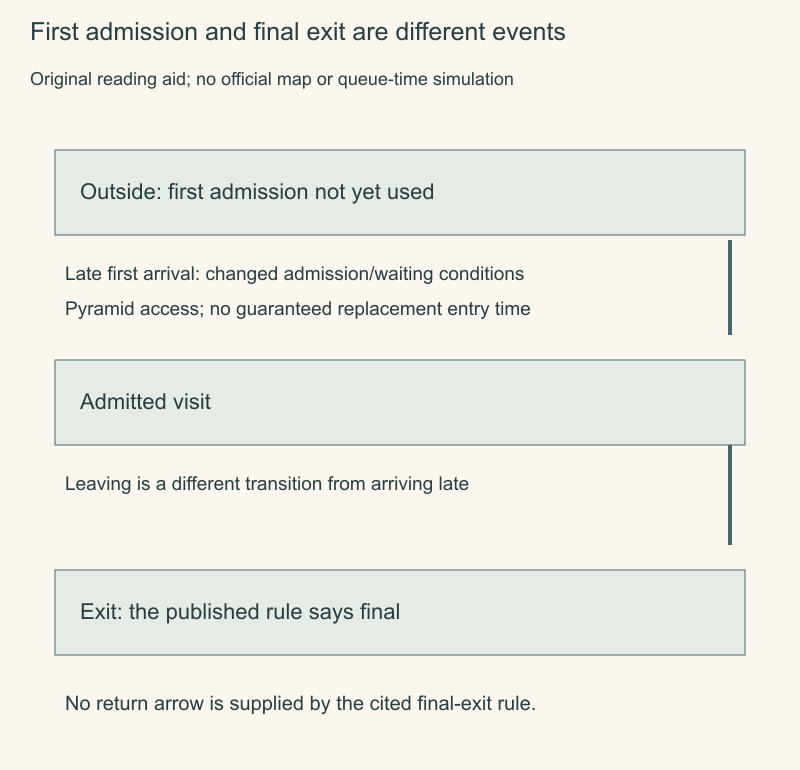
In an original state diagram, the path is outside before first entry, then admitted visit, then exit. The late-arrival note belongs beside the first transition. The final-exit note belongs beside the last. No return arrow is supplied. That drawing is a reading aid for the quoted conditions, not an official floor plan or a simulation of ticket scanning.
Make the lunch plan depend on the right boundary
Suppose an imagined companion has booked an outside lunch while the other person expects to continue looking afterward. Moving lunch later could preserve one continuous museum visit; leaving during the visit would raise the final-exit problem. The useful conversation is about that interruption, not whether both people possess a ticket with the same date.
A concrete message could read: I have not planned to exit during the museum visit because the published rule says an exit is final. Shall we meet outside after the visit is finished instead? This is an original planning message, not a request already accepted by the museum or a promise that a particular meeting place will be accessible.
An internal pause and a museum exit should not be conflated either. This article does not identify a cafe, route, amenity or threshold as being inside the admission boundary. If a proposed break depends on that distinction, ask staff before crossing it. A generic restaurant listing or a map showing proximity cannot establish that a particular door preserves admission.
Keep a changed plan from creating another assumption
A late arrival can make a fixed later appointment inconvenient, but the FAQ does not authorize changing that appointment on another provider's behalf. Similarly, a final exit does not establish a refund, replacement ticket or entitlement to a new slot. Those are additional questions requiring the applicable current terms rather than a conclusion inferred from these two passages.
Before buying a replacement or an add-on, establish what the current ticket and official support actually say about the intended visit. Record the precise unresolved question: first admission after the slot, or return after an exit. That wording gives support a concrete situation to address and avoids paying for something merely because two different rules have been blended into one vague worry.
The comparison here uses the public late-arrival FAQ, the re-entry FAQ and the museum-rules page as read for this article. It does not report an author visit, real admission result or live availability. For an actual trip, reread the current instructions and follow staff directions; the benefit of this example is a clearer distinction between events, not a guarantee about the day.
Sources & further reading
Published sources for the details and examples discussed in this story.