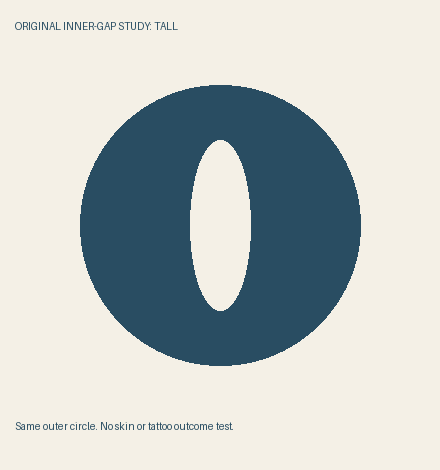
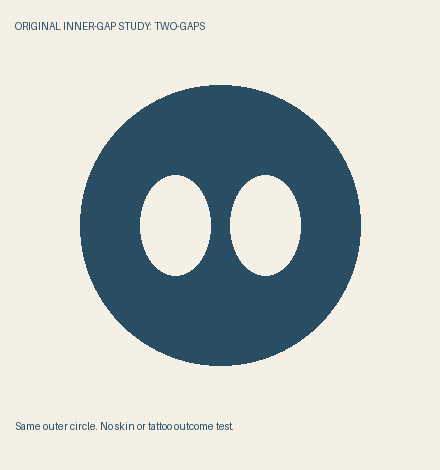
The empty part of a motif can be the feature that makes you want to keep looking. Three original digital paper studies hold one dark outer circle fixed and change only its inner gaps. One has a round opening, another a tall narrow opening and the third has two neighboring openings. They are flat shape proposals, not tattoo designs approved for skin. Nothing here predicts tattooability, healing, aging or the visibility of a particular gap after a procedure.
Keep the outside still long enough to notice the inside
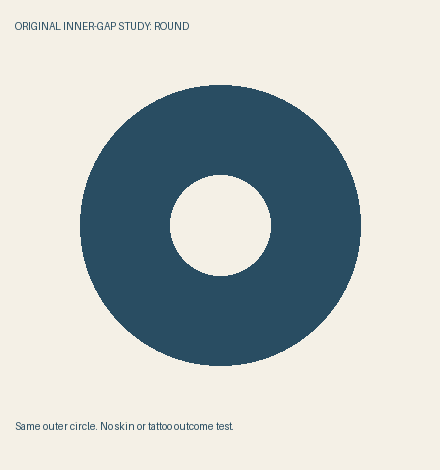
Each study begins with the same blue circle on a pale field. Its position, outer dimensions and color stay unchanged. The pale openings use the same color as the background, so they read as gaps in the dark field rather than as another applied decoration.
Getty’s formal-analysis vocabulary treats negative space as the area around the main objects and recognizes that such space has shape. Our study gives the internal empty area the attention usually reserved for the dark outline. That is a visual question, not a claim that an empty patch carries one established meaning across cultures.
Round: let the opening echo the boundary
The first version places a smaller round opening at the center. The inner and outer boundaries share a curved language, so I read the shape as a ring-like enclosure. The opening feels related to what surrounds it rather than introducing a new direction.
If the intended personal idea were continuity around a center, this would be a useful drawing to discuss. It would not prove that everyone reads it that way or that no existing symbol has a similar outline. Simple geometry can have many uses and associations beyond an individual sketch.
Tall: introduce a different direction inside the circle
The second study keeps the outside round but stretches the central gap vertically. There is more dark material beside the opening than above and below it in this drawing. I now notice a narrow passage inside a broader enclosing field.
This is my preferred paper version for a hypothetical idea about an opening within something protective. The preference comes from the contrast between a vertical inner shape and the round outside. It does not depend on claiming that the drawing resembles a real doorway, an anatomical location or a culturally authoritative emblem.
Two gaps: change the relationship, not the outer size
The third study divides the internal opening into two pale ovals. A dark strip separates them. Instead of one center, the image offers two neighboring spaces, and the strip between them becomes another feature to notice.
I would choose this version if the intended question were about two distinct spaces held within one boundary. It is not simply the first shape made more decorative. Dividing the gap changes the relationship available for discussion, even though the outer circle remains exactly the same.
Take a meaning question, not a predicted outcome
Keep the three drawings together with a short explanation of the preferred relationship. If they become part of a conversation with an appropriate tattoo professional, ask what the original idea could become within that professional’s process. Do not treat these digital holes as measurements or assume a visible paper gap will remain identical on skin.
No temporary colorant, skin test, procedure or product purchase is needed to complete this comparison. The drawings have already clarified a choice about internal shape. Practical suitability, permissions and individual health questions remain separate from liking one of the three paper studies.
Sources & further reading
Published sources for the details and examples discussed in this story.