A remembered makeup look can become a list of product names with no record of where they were used. A facechart gives those names places. This original chart records an existing look rather than teaching an application method. Its filled example is entirely invented: product names, shade identifiers and the imagined earlier use are fictional. The value is in seeing how a location and a product record can point back to each other.
Fix left and right before adding a mark
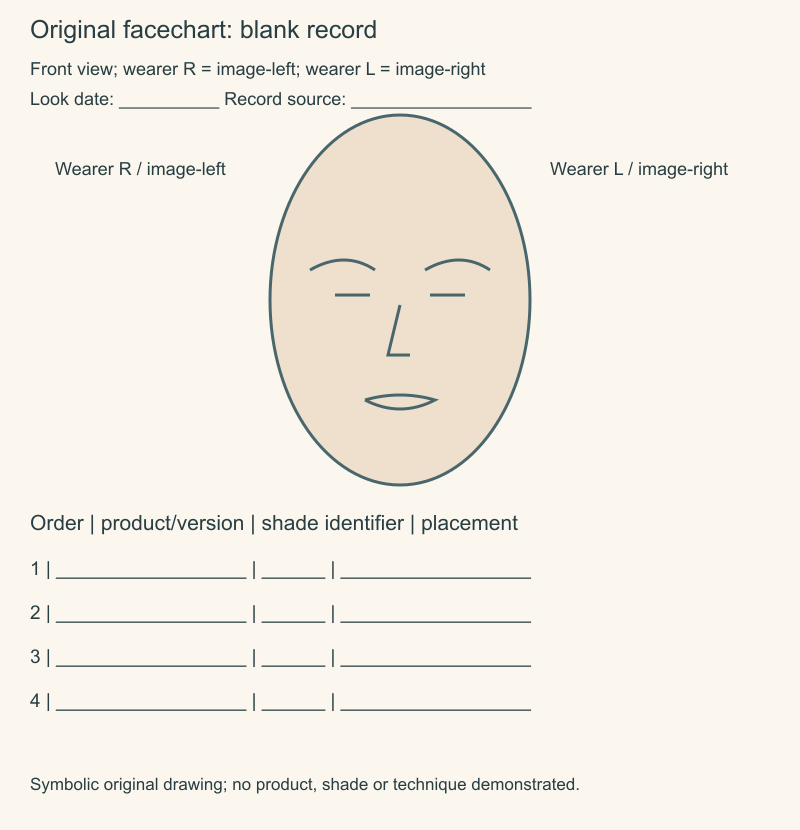
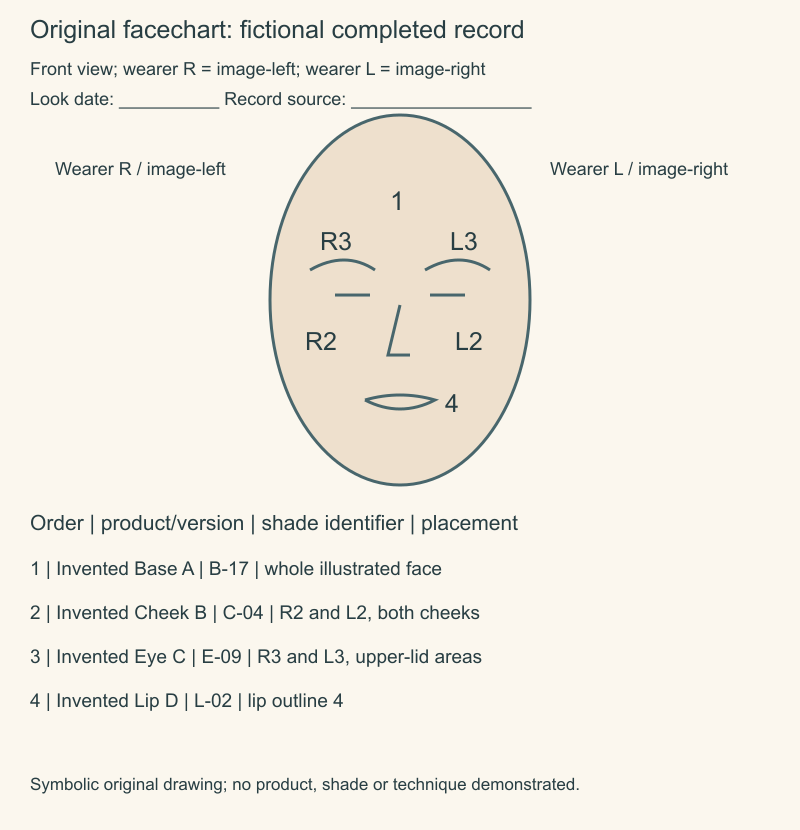
The chart shows a front view, as though looking at another person. The wearer's right is therefore on the left of the drawing; the wearer's left is on its right. Both conventions are printed on the blank and example. Write wearer R or wearer L in the record rather than relying on an unqualified left that could mean either the person or the page.
A location marker does not need to imitate the appearance of actual makeup. Here a labeled dot or short outline is enough. Keeping the marks symbolic makes the purpose clearer: R2 points to a row about the wearer's right cheek, rather than claiming that a colored dot reproduces a real product on skin.
Use the blank as a connected record
The blank supplies an original face outline and space for four numbered rows. Each row asks for order, exact product/version, shade identifier and placement. Add the date of the look being recorded and the source of your memory, such as your own contemporaneous note. If an identifier is missing, write unknown; a similar-looking product is not the same record.
First identify the areas you actually remember. Then give each product a sequence number and put that number beside the appropriate area. Use matching R and L suffixes where both sides matter. Repeated numbers mean the same recorded product was used in more than one place; they do not create additional products or tell someone how much to apply.
Read the complete fictional example
Row 1 is Invented Base A, shade B-17, placed across the illustrated face. Row 2 is Invented Cheek B, shade C-04, at both cheeks: marker R2 on image-left and L2 on image-right. Row 3 is Invented Eye C, shade E-09, at the two upper-lid areas labeled R3 and L3. Row 4 is Invented Lip D, shade L-02, on the lip outline marked 4.
The numbers preserve the imagined order 1, 2, 3, 4. The example is complete enough to check in both directions: find C-04 in the record and locate its two markers, or start at R3 and recover E-09 and its product name. The chart does not specify tools, quantities, technique or a safety assessment. It cannot establish whether a fictional product could actually produce the drawn appearance.
Keep a revision separate from the original look
If you later discover that the cheek identifier was copied incorrectly, correct the record while preserving what changed. If you instead choose another product for a future occasion, start a new version of the look. Replacing a row silently would make an old photograph and its chart disagree without explaining why.
A shopping list can be derived from confirmed product identities, but it is a separate document. Do not buy a substitute because the chart has an empty row or treat its illustrative sequence as instructions. The useful finished page lets you say what was recorded, where it went and what remains unknown, with a consistent front-view orientation another reader can follow.
Sources & further reading
Published sources for the details and examples discussed in this story.