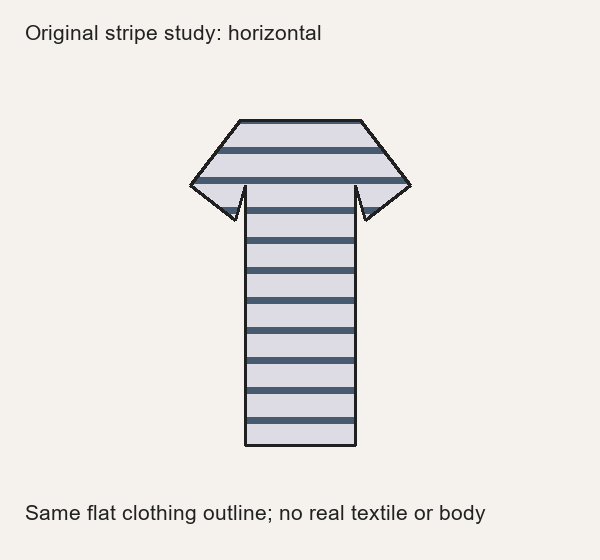
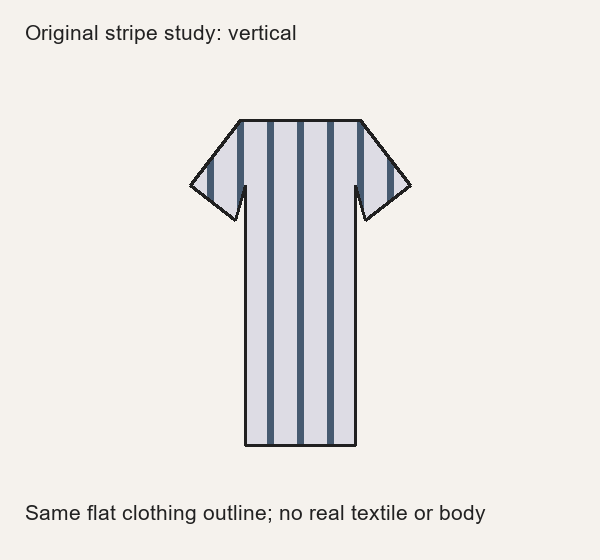
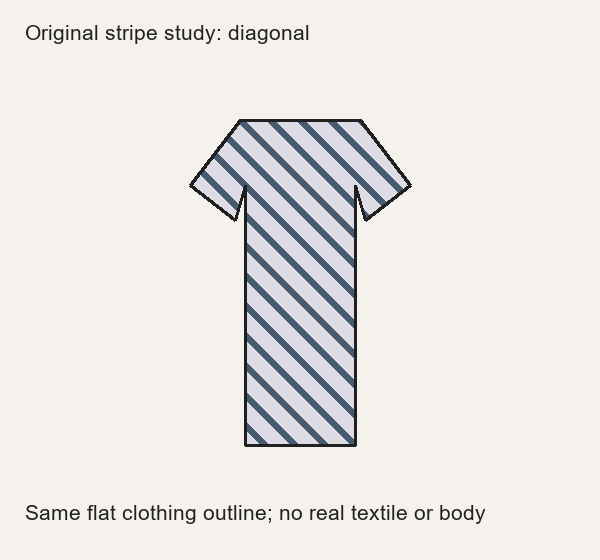
A stripe can be discussed as a line meeting an outline before it becomes a rule about someone’s body. These three original digital studies use one flat clothing shape with the same proportions in every image. The pale field and dark stripe color stay fixed, as do the line width and spacing measured perpendicular to the horizontal and vertical examples. Only the stripe direction changes. No garment has been made, worn or photographed for this comparison.
Read the outline before describing the lines
The drawn shape has a straight lower body, a broad upper edge and short angled sleeves. Its small underarm turns interrupt the long side boundaries. It is an invented paper-like clothing outline, without a person, drape or seam construction. Those turns give each stripe direction something specific to meet rather than allowing a general statement that stripes always do one thing.
The lines are generated at seven-pixel width with thirty-pixel offsets in the drawing code. The diagonal uses the same generator offset along the horizontal axis, so its perpendicular spacing differs from the horizontal and vertical cases. This is a declared graphic construction, not a matched textile-density experiment. The comparison concerns direction and edge encounters, not an isolated measurement of orientation.
Horizontal: repeated crossings of the long sides
In the horizontal study, each band crosses the body from one long side to the other. The lower portion becomes a stack of repeated crosswise marks. Near the angled sleeves, some lines have longer or differently interrupted spans. I would describe the rhythm as a succession of levels within the fixed outline, not as evidence that a wearer would look wider.
I would investigate this drawing if I wanted a design whose repetition could be counted down the image. The repeated horizontal stops interest me more here than an imaginary fit effect. An actual garment could introduce folds, seams or an interrupted print placement that this flat study has not supplied.
Vertical: let the bands run with the long boundary
The vertical study gives several bands a continuous run through the long body. At the sleeve angles, other bands end much sooner. The same outline therefore contains both sustained and truncated marks. I read the longer runs as relating to the body’s drawn side edges, while the short sleeve fragments keep the image from becoming a simple rectangle.
That is a different graphic question from whether vertical stripes are flattering. There is no body in the drawing and no wearer assessment. My preference would depend on whether those long runs were the feature I wanted to develop in a later design, not on a promise about another person’s proportions.
Diagonal: count the changes at the boundary
In the diagonal study, the lines meet the top, sides and angled sleeves at different points. Some short segments occupy the upper corners, while longer ones travel across the body. I find the alternation between these lengths more active than the even stack in the first study. That is a personal reading of the actual image, not a universal emotional effect.
Getty identifies direction as one of a line’s characteristics. This exercise uses that vocabulary without adopting a body-shaping rule or identifying a fabric from its appearance. Before ordering a striped item, its actual product views, dimensions and construction still matter. These drawings cannot establish how a print is matched at seams, how a cloth hangs or whether its repeat is identical to the digital proposal. They can, however, help you name which edge relationship you like before the word striped becomes the entire buying reason.
Sources & further reading
Published sources for the details and examples discussed in this story.