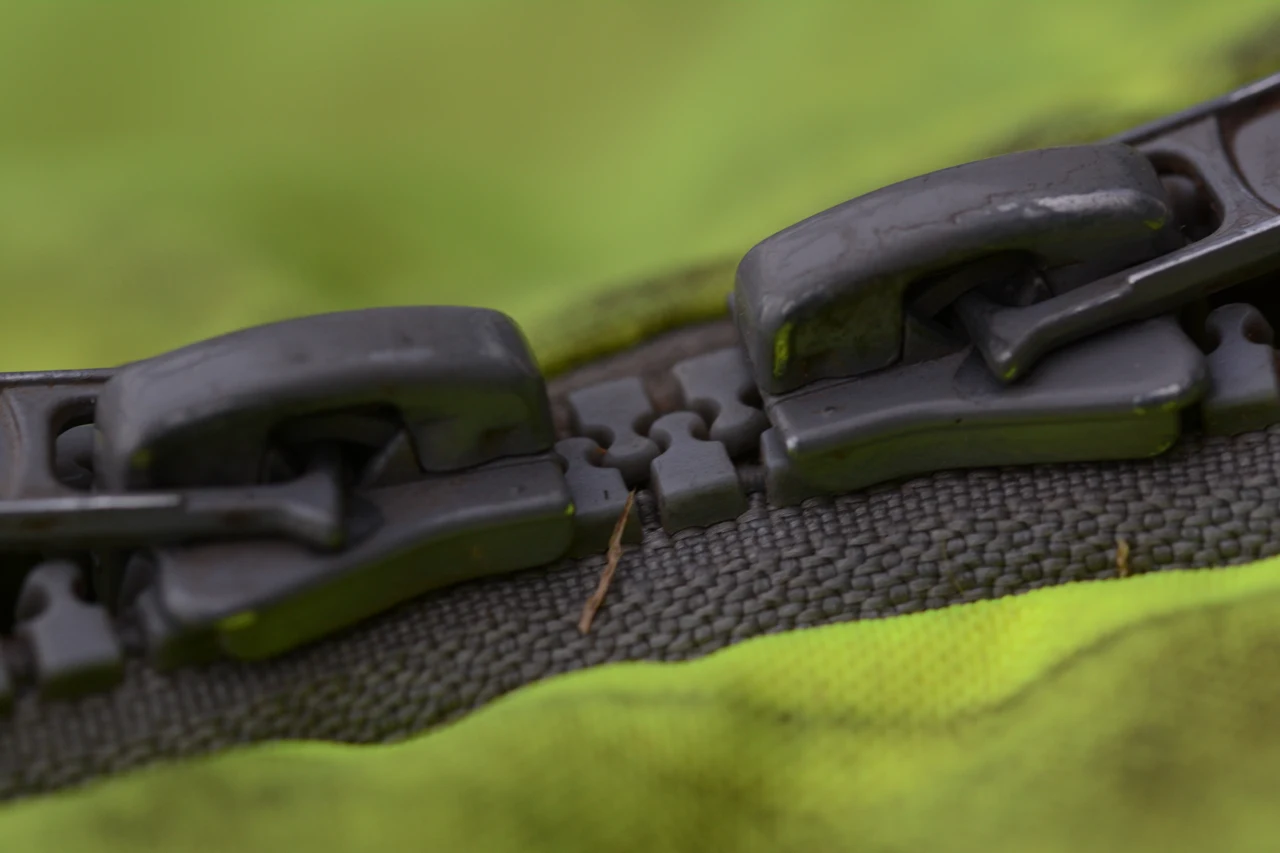
A zipper can have an opening arrangement you like and still leave another question unanswered: what holds the slider in place when the pull tab is no longer being held? YKK's explanation of automatic locking concerns that released-tab state. It is a different feature from opening a jacket at the bottom or reaching a pull from either face. This comparison reads the published functions, not an unidentified garment or a replacement part chosen from its appearance.
Begin with the state the question concerns
Imagine a product enquiry that asks only whether a closure is two-way. A useful answer could establish where the opening changes along the garment, while saying nothing about locking behavior after the tab is released. Similarly, a reversible pull can describe access from the other face without resolving the locking question. Keep those requested actions in separate sentences rather than allowing one reassuring label to answer all three.
The specific question here is what the documented slider is designed to do when no force is applied to its pull tab. That is a function to establish from the exact maker's description. It is not a request to pull on a closed garment, force a stuck zipper or reproduce a catalogue's strength test at home. No physical slider was operated for this article.
Read the automatic-lock explanation
YKK Group's Hidden Lock page distinguishes an illustrated jeans example whose tab position controls a lock pin from an automatic slider. In its automatic example, a light pull on the tab unlocks it without requiring the same ninety-degree raised position; when the tab is not held, it remains locked. The page says that an upper cover acts like a spring in the particular example shown.
The distinction matters because the description of one mechanism should not become a rule about every slider. I would not rewrite the automatic example as every zipper unlocks only when its tab is held at a right angle. That would import the illustrated jeans example's movement into the separate automatic explanation. The source itself marks different types and notes that other types exist.
The retained Asian-group slider catalogue provides a second, more systematic context. On printed page 3 it classifies sliders by locking function, describing locking when no force is applied to the pull tab and contrasting non-lock behavior. Its page 4 table identifies A as Automatic lock. These statements support the released-tab distinction, without identifying the hardware fitted to an unknown item.
Compare a non-lock function without calling it defective
The catalogue's page 4 table describes F, Non-lock, as having no locking mechanism and being free to open and close easily. Page3 explains the contrast using movement under force on the zipper. That is a documented function category, not evidence that every slider without automatic locking is broken or inferior.
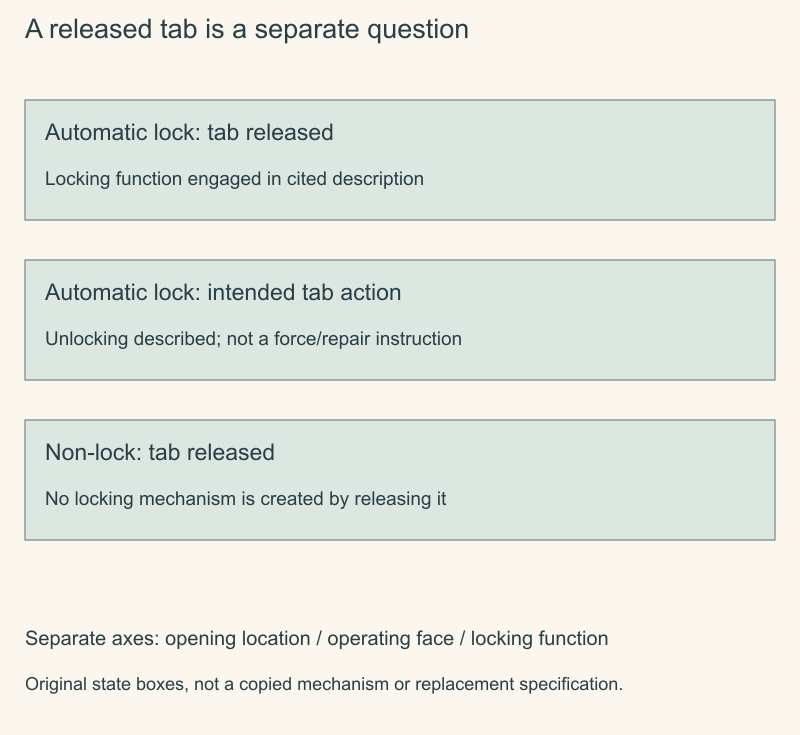
An original state comparison can therefore say: automatic-lock description, tab released, locking function engaged; automatic-lock description, appropriate tab action, unlocking described; non-lock description, no locking mechanism to engage merely because the tab is released. The drawing uses boxes and labels rather than copying YKK's mechanical illustrations or pretending to reveal the interior of a particular garment.
The catalogue mentions luggage as a use for non-lock sliders. That contextual example should not become an instruction to replace a garment slider with a luggage part. Application, zipper type, size and the actual product specification remain separate. A function label answers what kind of behavior is documented, not which component can be fitted to something already owned.
Read the table as functions, not a replacement list
The same catalogue table contains additional categories, including semi-automatic, double-pull and reversible entries. Their presence is useful even without reproducing every code. The table does not reduce all sliders to a single good/bad ranking. It separates several ways of controlling or accessing the slider.
For a shopping question, write the desired action: I want to know whether this exact closure has an automatic locking function when its pull tab is released. Then separately ask about bottom opening or operation from the garment's other intended face if those features matter. An answer about one should remain attached to that one action.
A maker could respond that the garment uses a particular documented function, that the listing needs clarification or that an existing item needs inspection. None of those outcomes requires the reader to infer a replacement code from the catalogue table. A printed A on a reference page is not proof that an unmarked household zipper uses that category.
Keep a purchase enquiry different from a repair diagnosis
Suppose an imagined shopper is comparing two listings. One names automatic locking; the other only names two-way opening. The first has supplied information relevant to the released-tab question. The second has not necessarily supplied a negative answer; it may simply be silent on that feature. The useful next step is an exact product enquiry rather than declaring one item defective from the difference in wording.
Now suppose the zipper is already owned and behaves unexpectedly. The function comparison cannot establish wear, damage, misuse or repair compatibility. Preserve the actual garment and maker information and use the appropriate repair-support route. No force, dismantling step or replacement purchase follows from this article.
The public YKK page was read through its full textual representation, including the explanatory image alternative text. The catalogue's necessary printed pages 3 and 4 were visually inspected from the retained PDF. The source drawings and product photographs are not reproduced here. The original diagram records a logical distinction between states, not a tested mechanism or a technical drawing suitable for manufacturing.
Sources & further reading
Published sources for the details and examples discussed in this story.