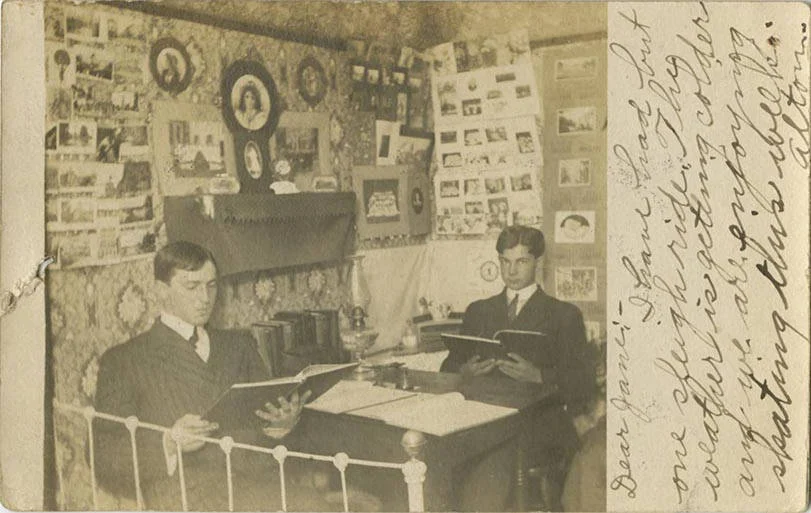
A postcard’s picture and message do not always invite the same pace. You might want to look at the image, turn the card and discover a short note. Or you might want both sides visible together so you can move between them without turning anything. For six wholly fictional two-sided cards, those are two different viewing plans. This is not an assessment of a real album, a conservation method or permission to reproduce somebody else’s image or correspondence.
| Plan | Viewing route | Positions to plan |
|---|---|---|
| Turnable album | A picture→A message, then B through F | Six card positions, both sides genuinely accessible |
| Paired facsimiles | A picture beside A message, repeated through F | Twelve displayed copy positions |
Give six invented cards individual identities
Label the imaginary cards A through F on a separate working plan. For each, distinguish a picture side and a message side. Card A might show an invented blue doorway while its original fictional message mentions waiting for rain to stop. Card B might show an invented hillside with a note about a late arrival. The other four also have two distinct sides; they are not filler images selected to complete a symmetrical wall.
These descriptions are authored examples, not scans of private mail or published postcards. No real sender, addressee or location is identified. That matters because a display decision can otherwise become a quiet decision to make personal writing public. Here we can compare the mechanics of looking without pretending that ownership of a physical card settles every privacy or reproduction question.
Plan A: picture, turn, message
For the album experience, imagine one suitable turnable leaf position for each card. The viewer begins with A’s picture, turns to A’s message, then moves to B’s picture and message. The route repeats until F. A page arrangement would need to keep both sides accessible without requiring repeated removal of an original; the actual product must establish how it does so.
This route lets the picture arrive before the message. A viewer can guess what the doorway means before finding the rain note, or turn back when the note changes their reading. It is a sequential encounter rather than a permanent view of twelve surfaces. The exercise specifies a desired reading order, not a claim that every transparent album pocket or binding will permit it.
Plan B: put each pair in view together
For the second experience, imagine front-and-back facsimiles that you are entitled to make and share. Pair A’s picture copy with A’s message copy, then do the same for B through F. The viewer can compare within a pair and across neighboring pairs. Six two-sided cards now require twelve displayed copy positions, not six frames each concealing one original side.
This can suit someone who wants to read the message while keeping the image in view. It gives up the small reveal created by turning the card. The pairing also needs a clear identity: A beside A, not a message placed beside a different picture because the colors coordinate. The arrangement is about reading a relationship, not making the correspondence look like anonymous decoration.
Buy for the route, and keep care separate
For Plan A, inspect the exact album’s usable dimensions, leaf construction and way of viewing both sides. For Plan B, count twelve copy positions and measure the full arrangement before buying display pieces. Neither plan automatically needs a large matching set. A small trial layout using your own original sample material can expose whether you actually enjoy turning or simultaneous comparison.
The Library of Congress advises against self-adhesive tape or glue on works on paper and recommends limiting light exposure; it also notes that different media can need different enclosure care. A product called archival does not clear every card or ink. This viewing comparison supplies no universal sleeve, adhesive or preservation guarantee. Fragile or valuable originals may need appropriate conservation advice before either plan becomes a physical display.
Sources & further reading
Published sources for the details and examples discussed in this story.